Caffeine avoidance is one of the most commonly repeated pieces of folk advice for tinnitus management. The belief that coffee, tea, and energy drinks worsen ringing is widespread in online forums and even some clinic waiting rooms. Controlled research has tested this idea, and the results are more nuanced than the advice usually acknowledges.
The origin of the advice
The recommendation to avoid caffeine likely comes from two sources. First, caffeine is a stimulant that increases alertness and arousal in the nervous system. Second, some early clinical observations suggested that caffeine intake was associated with higher tinnitus reports.
These are plausible mechanisms for concern, but plausibility is not the same as evidence. Caffeine increases neural activity broadly, which could in principle amplify any phantom neural signal. The question is whether this actually happens in ways that are clinically meaningful for tinnitus.
What withdrawal studies found
The most informative studies on this question involved systematically removing caffeine from participants’ diets and measuring the effect on tinnitus. If caffeine worsens tinnitus, removal should improve it.
The results across published trials have not consistently shown improvement in tinnitus following caffeine withdrawal. Several controlled studies found no significant change in tinnitus loudness or distress when participants switched from caffeine-containing beverages to decaffeinated alternatives under blinded or controlled conditions.
One notable finding is that caffeine withdrawal itself can worsen tinnitus temporarily through its general effects on the nervous system, including headache and irritability, rather than through any tinnitus-specific mechanism.
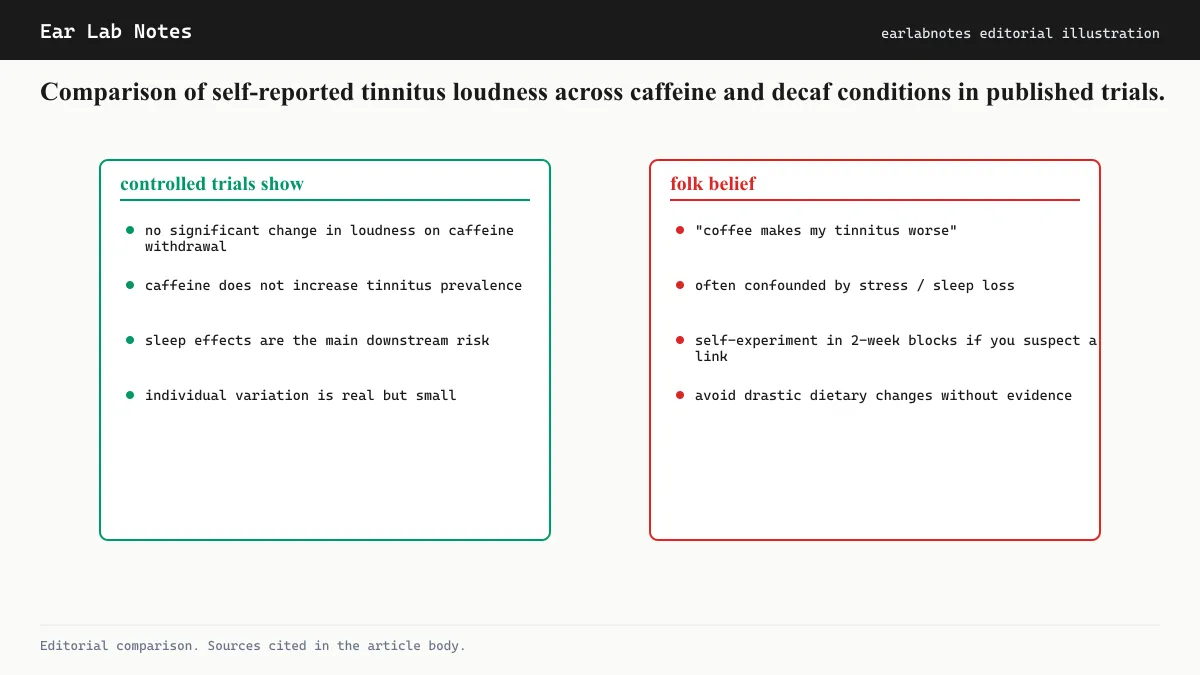
The BTA, which reviews lifestyle factors in tinnitus, does not list caffeine avoidance among its evidence-based recommendations. The absence of caffeine from its recommendations reflects the absence of consistent supporting evidence rather than an oversight.
Why individual experiences may differ
The lack of group-level evidence for a caffeine-tinnitus relationship does not mean every individual’s subjective experience is wrong. Several indirect pathways exist by which caffeine could influence how tinnitus is perceived.
Caffeine increases arousal, which can direct more attentional resources toward tinnitus. More attention to the sound generally means greater perceived intrusiveness, even if the objective signal from the auditory pathway is unchanged.
Caffeine disrupts sleep when consumed in the afternoon or evening. Sleep deprivation is reliably associated with worse tinnitus perception the following day. Someone who drinks coffee after noon and sleeps poorly may genuinely find their tinnitus worse the next morning, and attribute this to the coffee rather than the disrupted sleep.
Caffeine can exacerbate anxiety in sensitive individuals, and anxiety is one of the most powerful amplifiers of tinnitus distress.
These are real mechanisms, but they are indirect. They suggest that for some individuals, reducing or timing caffeine consumption differently might help, while not supporting a universal recommendation.
Caffeine and hearing
Caffeine does not appear to be ototoxic in standard clinical doses. The concern about tinnitus from caffeine is not based on cochlear damage. This distinguishes it from genuinely ototoxic substances such as high-dose aminoglycoside antibiotics or cisplatin chemotherapy, which directly damage cochlear structures.
NIDCD’s materials on ototoxic substances do not list caffeine among compounds that cause hearing damage. The relationship, if it exists, is indirect through the nervous system rather than structural.
What this means practically
The evidence does not support eliminating caffeine as a tinnitus management strategy for the general population with tinnitus. For most people, removing coffee from their diet based on this concern alone is unlikely to produce a meaningful change.
That said, there are other good reasons to consider caffeine timing and quantity. Caffeine that disrupts sleep is a factor worth examining regardless of tinnitus, because sleep disruption worsens tinnitus regardless of cause. Caffeine that contributes to anxiety or stress is similarly worth examining.
For someone who notices a consistent personal relationship between caffeine and tinnitus severity, tracking intake alongside tinnitus perception for a few weeks is a reasonable self-observation experiment. Individual biology varies, and there is no reason to dismiss a consistent pattern someone observes in themselves.
The Mayo Clinic’s general tinnitus management guidance notes that some people find certain foods, drinks, or substances appear to influence their tinnitus and suggests noting patterns, while acknowledging that controlled evidence for dietary interventions in tinnitus is limited overall.
If symptoms persist or change, see an audiologist or physician.
Related notes
Frequently asked
Questions readers ask
- Should people with tinnitus avoid coffee?
- Current evidence does not support caffeine avoidance as a general recommendation for tinnitus. Controlled studies have not found a consistent relationship between caffeine intake and tinnitus loudness or distress.
- Why do some people feel their tinnitus worsens after coffee?
- Individual variation is real. Caffeine increases alertness and arousal, which can direct more attention toward tinnitus. Sleep disruption from late caffeine intake can also amplify tinnitus the following day. These subjective effects may be real even if caffeine does not directly worsen the phantom signal.
- What about energy drinks or high-caffeine products?
- Energy drinks contain caffeine in quantities similar to or greater than coffee, and some also contain other stimulants. Sleep disruption and anxiety from high stimulant doses can indirectly worsen tinnitus distress. This is distinct from a direct ototoxic or cochlear effect.
- Is caffeine ototoxic?
- Based on available evidence, caffeine is not considered ototoxic. The concern about caffeine and tinnitus relates to its stimulant effects on the nervous system rather than any direct damage to the cochlea or auditory nerve.
- Should I suddenly cut caffeine out to see if my tinnitus improves?
- Rapid caffeine withdrawal produces its own symptoms, including headache and increased fatigue, which can themselves affect how tinnitus is perceived. Any reduction in caffeine intake is better done gradually, and the likely magnitude of effect on tinnitus is modest based on current evidence.
Primary sources
Where this comes from
- ◆Tinnitus · National Institute on Deafness and Other Communication Disorders (NIDCD)
- ◆Tinnitus: Diagnosis and Treatment · Mayo Clinic
- ◆Lifestyle and Tinnitus · British Tinnitus Association (BTA)
- ◆Clinical Practice Guideline: Tinnitus · American Academy of Otolaryngology-Head and Neck Surgery (AAO-HNS)
Educational use only.
If your symptoms persist or change, see a licensed audiologist or otolaryngologist. Sudden hearing loss is a medical emergency, see a clinician within 72 hours.
TEL-N006 · The Ear Lab · earlabs.app