Why decibels exist
The human ear can detect sounds across an astonishing range. At the quiet end, a healthy young person can hear sounds with pressure fluctuations of less than 20 micropascals, which is roughly the diameter of a hydrogen atom in the displacement it produces at the eardrum. At the loud end, sounds above about 200,000 micropascals cause immediate pain and rapid hearing damage.
If you tried to put all of that on a linear scale, the numbers would be unwieldy. The faintest audible sound might be marked as 1 unit, while a jet engine would need to be marked as about 10,000,000 units. Working with numbers that span seven orders of magnitude is inconvenient.
The decibel scale solves this by using logarithms. Instead of measuring sound pressure directly, decibels measure the ratio of sound pressure to a reference pressure, expressed as a log. The result is that the entire range of human hearing fits neatly between 0 and 140 on the scale.
The math, briefly
A decibel (dB) is one-tenth of a bel, named after Alexander Graham Bell. The formula for sound pressure level is:
dB-SPL = 20 × log₁₀ (P / P₀)
Where P is the measured sound pressure and P₀ is the reference pressure of 20 micropascals (the approximate threshold of human hearing).
Because of the logarithmic relationship, every 20 dB increase corresponds to a 10-fold increase in sound pressure. But loudness perception does not scale the same way as pressure. A 10-fold pressure increase (20 dB) sounds roughly 4 times louder to most listeners. A 10 dB increase sounds roughly twice as loud to most listeners.
This distinction matters practically. When someone says “this location is 20 dB louder than that one,” the physical difference is large (10 times the pressure) but the perceptual difference is more moderate (about 4 times louder to a listener).
The four scales you will encounter
dB-SPL: physics
dB-SPL is the base measurement of sound pressure level relative to the 20-micropascal reference. It is a physical measurement that does not account for how humans perceive different frequencies. A 60 dB-SPL tone at 1,000 Hz sounds louder to a person than a 60 dB-SPL tone at 100 Hz because the ear is more sensitive in the mid-frequency range.
dB-SPL appears on sound-level meters and in acoustic engineering. It is the starting point from which other scales are derived.
dB(A): weighted for human hearing
dB(A) applies a frequency-weighting filter called the A-weighting curve. The A-weighting curve is a mathematical approximation of the human ear’s sensitivity across frequencies at moderate sound levels. It attenuates low and very high frequencies relative to the mid-frequency range where hearing is most sensitive.
The result is a single number that better predicts the damage potential of a complex sound for human hearing than an unweighted dB-SPL measurement would.
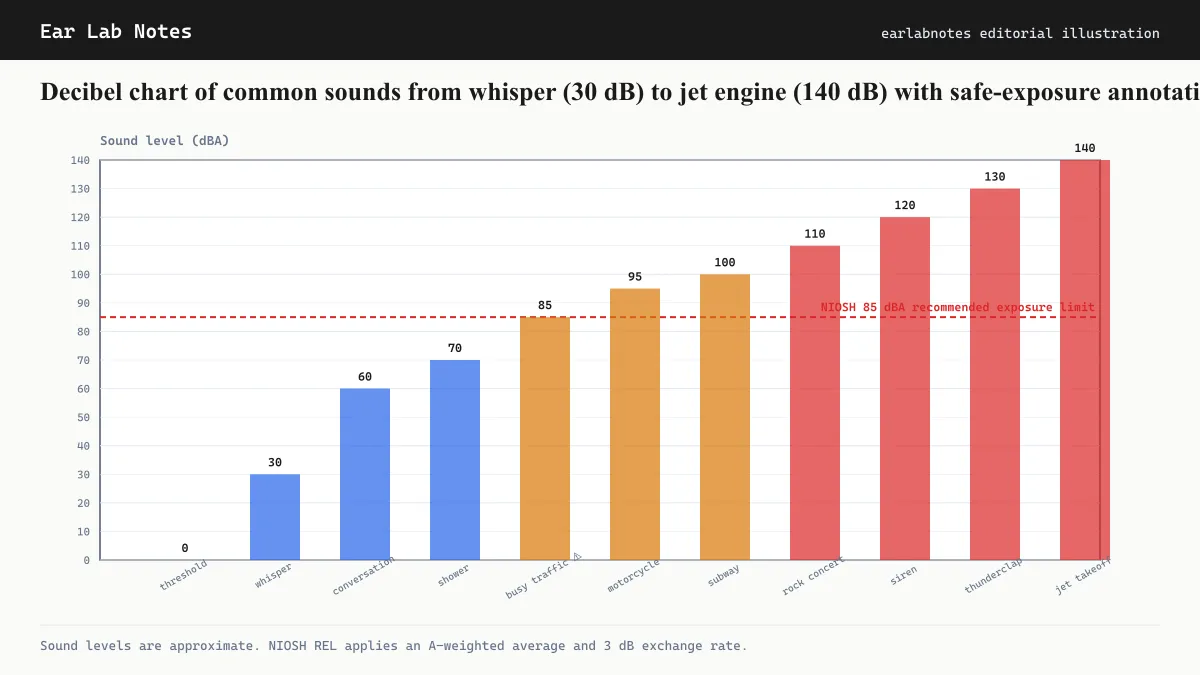
NIOSH uses dB(A) for its occupational noise exposure criteria. Their recommended exposure limit is 85 dB(A) for an 8-hour workday, with a 3 dB exchange rate: each 3 dB increase halves the safe exposure time. At 88 dB(A), the limit is 4 hours. At 100 dB(A), the limit is about 15 minutes. The NHS UK notes similar exposure guidance for understanding noise risk.
Consumer headphone volume limits, workplace regulations, and most hearing-conservation programs use dB(A).
dB-HL: audiometric
dB-HL (hearing level) appears on audiograms and nowhere else. It has a different zero point from dB-SPL. Zero dB-HL does not mean silence in an absolute physical sense. It means the average threshold of a young adult with no hearing loss, as established by audiometric norms.
Because the ear is more sensitive at some frequencies than others, the physical sound pressure corresponding to 0 dB-HL varies across frequencies. At 1,000 Hz, 0 dB-HL corresponds to about 7 dB-SPL. At 125 Hz, 0 dB-HL corresponds to about 47 dB-SPL. The audiogram’s dB-HL scale has, in effect, already accounted for the frequency-sensitivity differences of a normal ear.
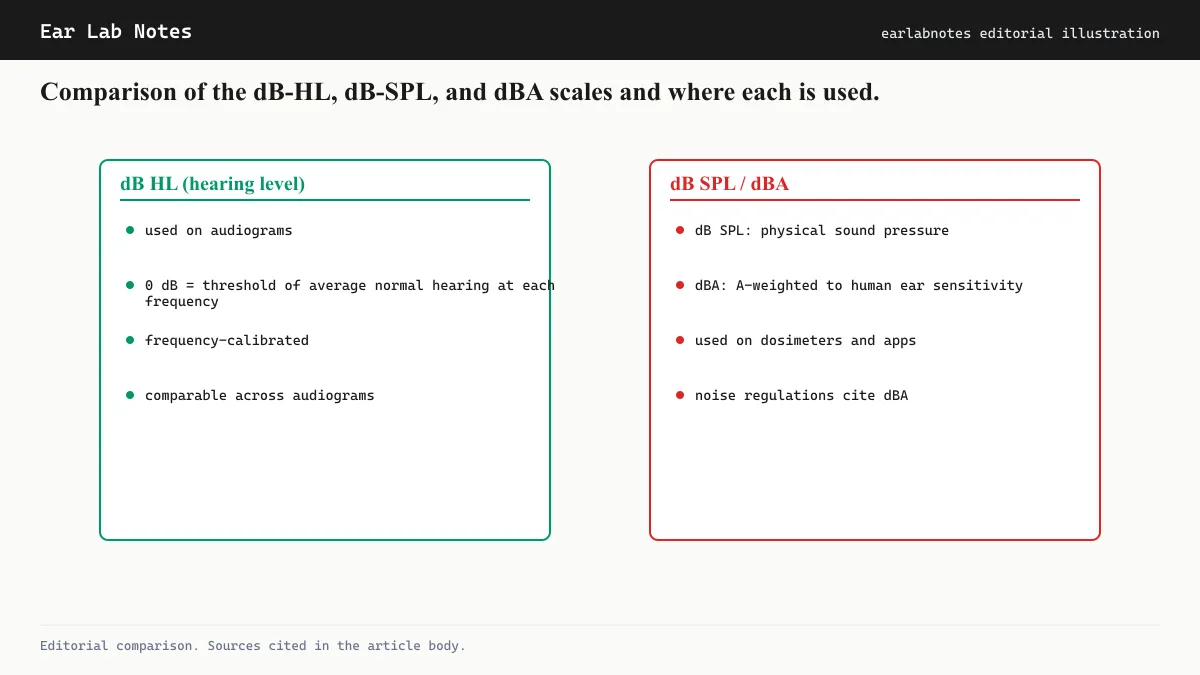
When an audiologist marks your thresholds on an audiogram, a result of 30 dB-HL at a given frequency means you needed a tone 30 dB louder than the normal reference before you could detect it at that frequency.
dB-SL: sensation level
dB-SL (sensation level) is less commonly encountered but appears in research. It expresses sound level relative to an individual’s own threshold at a given frequency. A tone at 20 dB-SL is 20 dB above the person’s own threshold at that frequency, regardless of what that threshold is in absolute terms. This scale is used when testing suprathreshold hearing abilities.
NIOSH exposure standards and hearing risk
NIOSH publishes permissible exposure limits for occupational noise based on extensive research into noise-induced hearing loss. The key figures:
- 85 dB(A): maximum for 8-hour workday
- 88 dB(A): maximum for 4-hour workday
- 91 dB(A): maximum for 2-hour workday
- 94 dB(A): maximum for 1-hour workday
- 97 dB(A): maximum for 30-minute exposure
- 100 dB(A): maximum for 15-minute exposure
These limits represent maximum cumulative exposure, not individual events. A worker can have multiple shorter exposures across a shift; what matters is the total dose.
The Occupational Safety and Health Administration (OSHA) uses a 5 dB exchange rate rather than NIOSH’s 3 dB, which produces more permissive limits at higher decibel levels. NIDCD materials consistently reference the more conservative NIOSH criteria as the basis for hearing-health guidance.
Common sounds in context
The range of everyday sounds, expressed in approximate dB-SPL, gives practical grounding to the scale:
- Whisper at 1 meter: 30 dB
- Quiet library: 40 dB
- Normal conversation: 60 dB
- Busy restaurant: 70 to 75 dB
- City traffic from sidewalk: 80 to 85 dB
- Motorcycle (nearby): 95 dB
- Earbuds at full volume: 105 to 115 dB
- Live concert front of house: 110 to 120 dB
- Jet engine at 100 meters: 140 dB
For reference, NIOSH’s 85 dB(A) 8-hour limit sits between busy restaurant background noise and heavy city traffic. Concert-level sound at 110 dB carries a safe exposure time under NIOSH criteria of about 1 minute and 53 seconds.
What the scale does not capture
dB measures intensity and time. It does not capture all factors relevant to hearing damage. Frequency (some frequency ranges are more damaging than others for the cochlea), individual susceptibility (genetic and physiological variation is significant), and intermittency (noise with recovery periods between exposures is generally less damaging than continuous noise at the same average level) all matter but are not represented in a single dB reading.
This is why any single dB exposure figure comes with caveats in clinical guidance, and why hearing conservation involves multiple strategies rather than simply staying below a threshold number.
If symptoms persist or change, see an audiologist or physician.
Related notes
Frequently asked
Questions readers ask
- Why is the decibel scale logarithmic?
- The human auditory system responds to sound pressure ratios rather than absolute differences. A sound that is 10 times more intense than another does not sound 10 times louder; it sounds roughly twice as loud. The logarithmic scale compresses the enormous range of sound pressures the ear can handle (a ratio of about 1 million to 1 in pressure amplitude) into a manageable numeric range.
- What is the difference between dB-SPL and dB-HL?
- dB-SPL (sound pressure level) is a physical measurement: the ratio of a sound pressure to a reference pressure of 20 micropascals. dB-HL (hearing level) is calibrated to human audiometric norms. On an audiogram, 0 dB-HL represents the average threshold of a young adult with no hearing loss, not silence. The two scales do not have the same zero point.
- What does dB(A) mean on headphones or workplace regulations?
- dB(A) applies a weighting filter that mimics how the human ear is less sensitive to very low and very high frequencies. It is the standard scale for occupational noise regulations (NIOSH, OSHA) and for most consumer product noise labels because it better reflects the damage potential of sound on human hearing than unweighted dB-SPL.
- Is 85 dB always safe for hearing?
- 85 dB(A) is the level at which NIOSH recommends limiting continuous daily exposure to 8 hours. Above 85 dB, safe exposure time drops with each 3 dB increase under NIOSH criteria. At 88 dB, the recommended limit is 4 hours; at 91 dB, 2 hours. There is no 'safe' level for arbitrarily long exposure.
- Why does a 10 dB increase sound twice as loud?
- The perception of loudness follows an approximate power function. A 10 dB increase represents a 10-fold increase in sound intensity, which most people perceive as roughly double the loudness. This relationship is an approximation; individual perception varies.
Primary sources
Where this comes from
- ◆Noise and Hearing Loss Prevention · NIOSH/CDC
- ◆Noise-Induced Hearing Loss · NIH/NIDCD
- ◆How Do We Hear? · NIH/NIDCD
- ◆Loud noise dangers · NHS UK
Educational use only.
If your symptoms persist or change, see a licensed audiologist or otolaryngologist. Sudden hearing loss is a medical emergency, see a clinician within 72 hours.
TEL-N009 · The Ear Lab · earlabs.app