Hearing loss and tinnitus are closely linked. According to the NIDCD, the majority of people with chronic tinnitus also have some degree of measurable hearing loss, and tinnitus is most often a symptom of underlying changes in the auditory system rather than a standalone condition. When hearing loss is present, hearing aids are one of the most commonly discussed management tools.
Why hearing loss makes tinnitus more noticeable
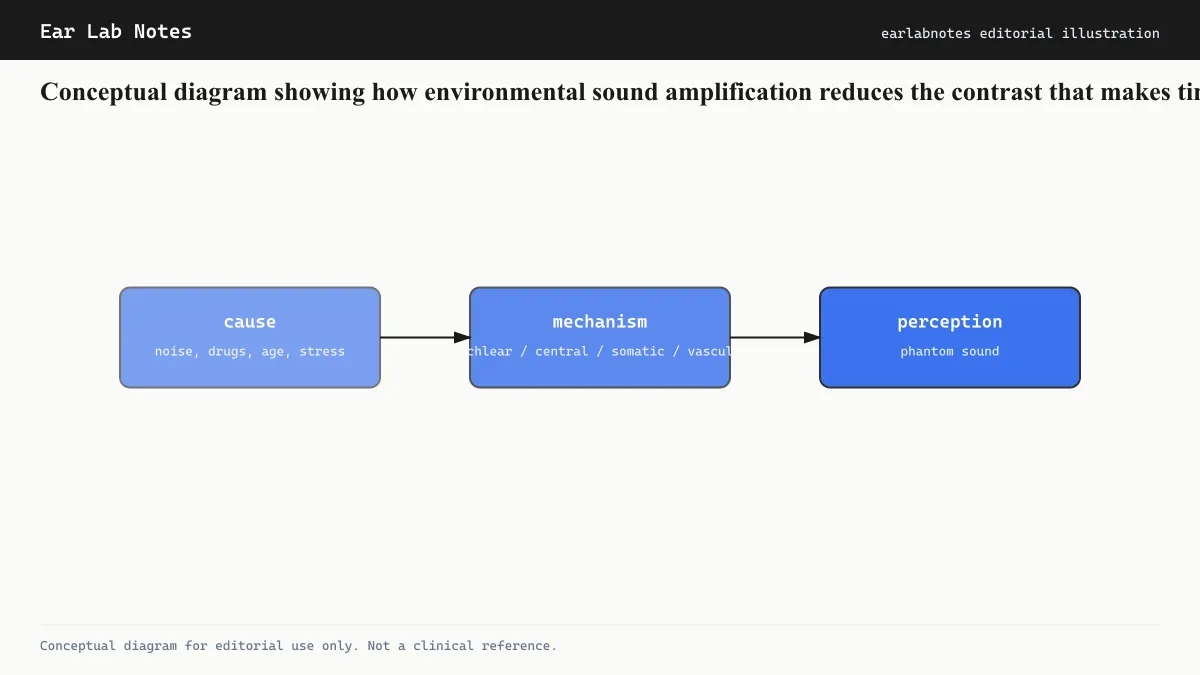
The auditory system is not passive. When the cochlea delivers less signal, the brain compensates by turning up its internal gain. Researchers refer to this as central gain, and it is currently one of the dominant models for why tinnitus is perceived as loud even when external sound is quiet.
In a quiet room, the gap between the phantom tinnitus signal and environmental background sound is large. That contrast is part of what makes ringing feel so intrusive. Hearing aids partially address this by bringing environmental sounds back up to audible levels, which narrows the contrast.
How amplification changes tinnitus perception
Hearing aids do not suppress the tinnitus signal at its source. The phantom sound is generated in the central auditory nervous system and cannot be switched off by peripheral amplification. What changes is the perceptual environment around it.
When the hearing aid restores ambient sound, the brain has more external input to process. Several things follow from this. The background noise floor rises, reducing how much the tinnitus stands out. Attention naturally shifts toward the environmental sounds that are now audible. And, according to AAO-HNS clinical guidelines, some people experience a reduction in tinnitus loudness that persists even after the hearing aid is removed, though this is not universal.
What the evidence says
The AAO-HNS clinical practice guideline on tinnitus recommends that clinicians evaluate patients for hearing loss and discuss amplification options when loss is present. The guideline specifically identifies hearing aids as a reasonable option for tinnitus management in this population.
The British Tinnitus Association (BTA) similarly notes that hearing aids are among the most commonly offered interventions for tinnitus accompanied by hearing loss, and that many patients report reduced tinnitus annoyance after fitting.
Importantly, the evidence does not support hearing aids as a universal tinnitus treatment. People whose audiograms show no significant hearing loss have fewer reasons to expect benefit from amplification alone.
Combination devices: amplification plus sound therapy
Some hearing aids include a built-in sound generator, a second function that produces a soft broadband noise or other therapeutic sound independently of the amplification function. These are called combination devices.
The rationale comes partly from tinnitus retraining therapy (TRT), which uses low-level broadband sound to help the auditory system habituate to tinnitus. Combination devices can deliver both functions simultaneously, which some audiologists find useful when a patient has both measurable hearing loss and significant tinnitus distress.
The AAO-HNS guideline notes that sound therapy, including the type delivered via combination devices, is one option clinicians may offer alongside counseling.
Practical considerations
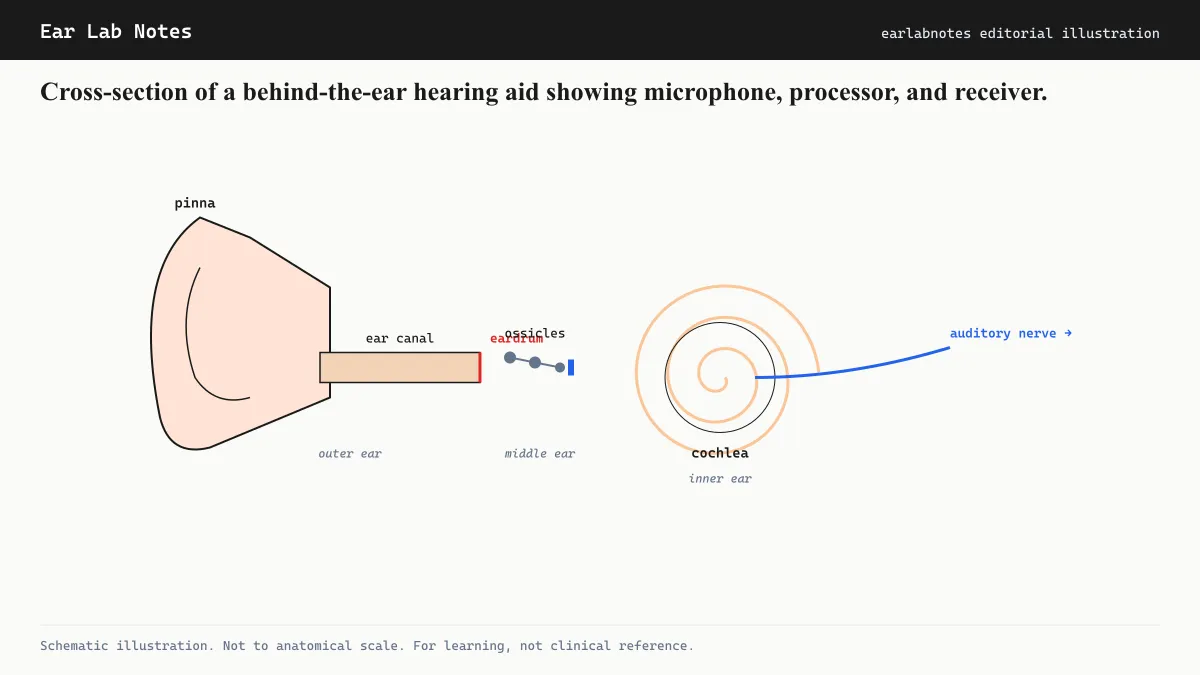
Getting hearing aids fitted involves more than simply selecting a device. An audiologist first performs a comprehensive audiometric evaluation to determine the type and degree of hearing loss. The fitting process involves programming the device to match the specific pattern of the patient’s hearing thresholds.
For tinnitus, the frequency profile of the hearing loss matters. Noise-induced hearing loss, for example, typically affects high frequencies (around 4 kHz), and the hearing aid programming needs to adequately address that range. A poorly fitted device that does not amplify the frequencies where the hearing loss is greatest may provide little tinnitus relief even if it technically improves overall audibility.
Adjustment takes time. The brain needs weeks to adapt to amplified sound after a period of loss, and it is common to find certain sounds initially too loud or tinny. Audiologists typically schedule follow-up appointments to fine-tune the programming.
Trial periods and return policies
Most jurisdictions that regulate hearing aids require manufacturers and dispensers to offer a trial period. In the United States, the Food and Drug Administration and many states have rules about return windows. Asking about the return policy before purchase is practical, particularly since tinnitus response to amplification can be unpredictable.
Over-the-counter hearing aids
In 2022, the U.S. FDA finalized rules allowing over-the-counter hearing aids for adults with mild to moderate hearing loss. These devices do not require a professional fitting and are available at lower cost than prescription aids.
For tinnitus specifically, OTC aids have not been studied as extensively as professionally fitted devices. The benefit of working with an audiologist is that programming can be tailored to the specific audiometric profile, which matters when hearing loss is part of the tinnitus picture.
What hearing aids cannot do
It is worth being clear about limits. Hearing aids do not restore damaged hair cells. They do not change the underlying neural mechanisms that generate tinnitus. They are a management tool, not a treatment for the root cause. For some people they make a meaningful difference in daily function and tinnitus annoyance; for others the effect is modest.
The Mayo Clinic notes that tinnitus management typically requires multiple strategies, and that no single approach works for everyone. Hearing aids are one component that may be relevant when hearing loss is present, not a standalone solution.
If symptoms persist or change, see an audiologist or physician.
Related notes
Watch
Progressive Tinnitus Management (PTM)
Source: VA National Center for Rehabilitative Auditory Research on YouTube
Transcript / summary
Frequently asked
Questions readers ask
- Do hearing aids cure tinnitus?
- No. Hearing aids do not eliminate tinnitus. For many people with concurrent hearing loss, amplification reduces how noticeable the ringing is during daily activities, but the phantom sound remains present.
- Can I get a hearing aid just for tinnitus if my hearing test is normal?
- Standard hearing aids are indicated for measurable hearing loss. If your audiogram is normal, an audiologist would typically explore other management options before recommending amplification.
- What is a combination device?
- A combination device is a hearing aid that also contains a built-in sound generator. It can amplify environmental sound and simultaneously produce a gentle masking noise, offering both features in one unit.
- How long does it take to notice a difference?
- Adjustment to hearing aids typically takes several weeks. Some people notice a reduction in tinnitus salience within the first few days; others require a longer adaptation period. Individual responses vary considerably.
- Are all hearing aids the same for tinnitus?
- No. Devices vary in their sound-processing features, the frequency range they amplify, and whether they include built-in sound therapy programs. An audiologist can discuss which options may be relevant to your specific pattern of hearing loss.
Primary sources
Where this comes from
- ◆Tinnitus: Diagnosis and Management · National Institute on Deafness and Other Communication Disorders (NIDCD)
- ◆Clinical Practice Guideline: Tinnitus · American Academy of Otolaryngology-Head and Neck Surgery (AAO-HNS)
- ◆Tinnitus · Mayo Clinic
- ◆Tinnitus · NHS UK
Educational use only.
If your symptoms persist or change, see a licensed audiologist or otolaryngologist. Sudden hearing loss is a medical emergency, see a clinician within 72 hours.
TEL-N012 · The Ear Lab · earlabs.app