Mindfulness-based stress reduction and its close relative mindfulness-based cognitive therapy have attracted growing interest as management tools for chronic tinnitus. The claims made in popular media often overstate what the evidence shows, so this article tries to set out what the trials actually measured, what they found, and where the honest uncertainties remain.
What mindfulness-based programs are
Mindfulness-based stress reduction (MBSR) was developed by Jon Kabat-Zinn at the University of Massachusetts in the 1970s for chronic pain and stress-related conditions. The standard program runs eight weeks, involves weekly group sessions of two to three hours, and requires daily home practice of 30 to 45 minutes using guided meditations.
Mindfulness-based cognitive therapy (MBCT) was adapted from MBSR and originally developed for preventing depression relapse. It adds cognitive therapy techniques to the mindfulness foundation. Both programs teach participants to observe thoughts, sensations, and sounds without automatically reacting to them.
Applied to tinnitus, this means practicing awareness of the ringing without the habitual avoidance, frustration, or anxiety that often accompanies it. The hypothesis is that it is not the tinnitus itself but the reactive relationship to it that generates most of the suffering.
What mindfulness programs do not claim to do
This point matters because it is frequently misrepresented. MBSR and MBCT are not designed to reduce tinnitus loudness. They do not target the cochlea or the auditory cortex in ways that would diminish the phantom signal. The goal is changing the relationship to the experience rather than changing the experience itself.
In practical terms, this means that a successful outcome in a mindfulness program for tinnitus might look like: the ringing is unchanged in objective terms but feels less threatening, intrudes less on daily activities, and triggers less anxiety or distress. Researchers typically measure outcomes using tinnitus-specific distress scales rather than pitch-matching or loudness-matching audiometric measures.
The evidence base
Controlled trials of MBSR and MBCT for tinnitus exist, though the literature is smaller than for cognitive behavioral therapy (CBT). A reasonable summary, consistent with the BTA’s discussion of the evidence, is that mindfulness-based programs show modest to moderate reductions in tinnitus distress, with effects that appear to be maintained at follow-up assessments of three to six months.
Studies face methodological challenges common in this research area. Blinding is difficult because participants know whether they are in a mindfulness group. Control conditions vary. Samples are often small. These limitations mean the evidence is encouraging but not definitive.
The AAO-HNS clinical practice guideline on tinnitus notes that psychological and behavioral interventions, including those based on mindfulness, are relevant management options for patients with significant tinnitus distress. The guideline does not rank mindfulness above or below CBT for this purpose; both are framed as options a clinician might discuss.
How mindfulness addresses tinnitus distress specifically
The proposed mechanism runs through attentional regulation and the limbic system’s response to the tinnitus signal.
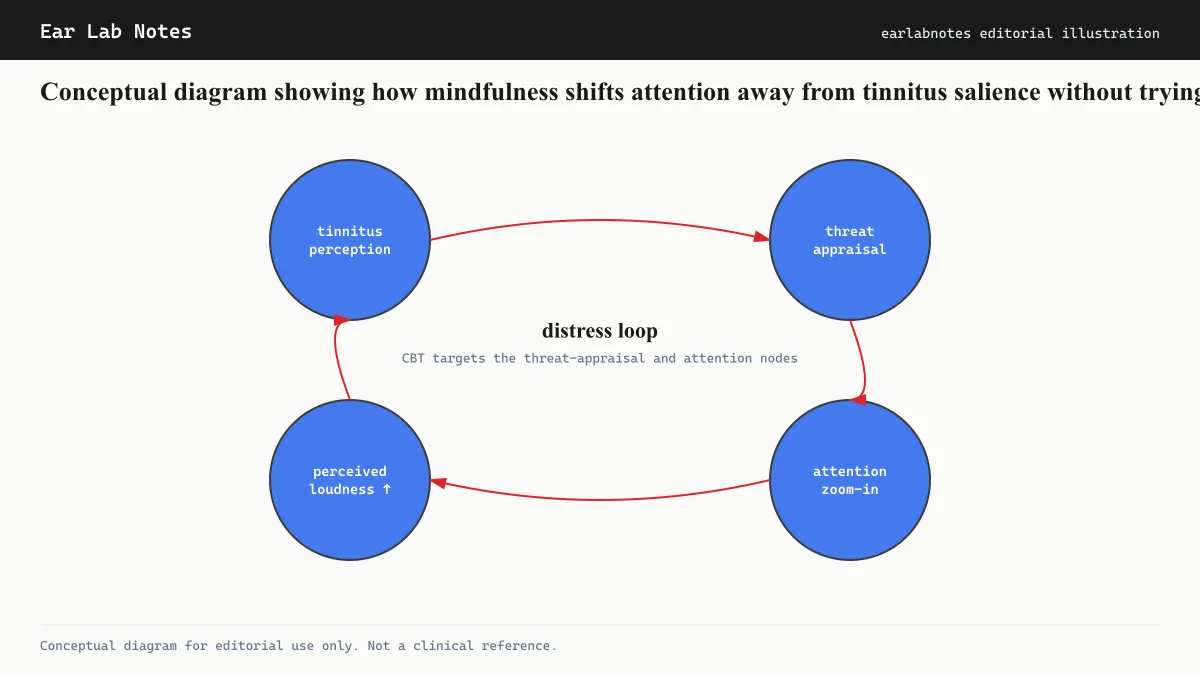
Tinnitus becomes distressing partly because it triggers the threat-detection system. The brain treats an unidentifiable, unpredictable sound as potentially dangerous and generates anxiety. Anxiety increases auditory vigilance, which means more attention is directed at the sound, which makes it more salient. This loop is sometimes called the tinnitus reaction cycle in clinical literature.
Mindfulness practice trains the ability to notice the tinnitus and the reactive emotions it triggers without automatically amplifying them. With practice, the observation “I am noticing the ringing and I am noticing I feel anxious about it” begins to replace the more fused reaction of “the ringing is unbearable.” That shift in relationship to the experience is the therapeutic target.
This is conceptually aligned with the CBT model for tinnitus, which similarly targets the cognitive and emotional responses to the sound rather than the sound itself. The practical difference is that mindfulness focuses more on present-moment awareness and less on explicitly restructuring thoughts.
Practical considerations
Standard MBSR and MBCT programs require a significant time commitment. Daily practice of 30 to 45 minutes is the norm in published protocols. People with demanding schedules or who find formal sitting meditation uncomfortable may have difficulty sustaining this. Shorter practices exist and have been studied, but the evidence base is smaller.
Group programs are available in many areas through hospitals, clinics, and community organizations. Audiologists who specialize in tinnitus sometimes offer programs that combine mindfulness with other elements, including sound therapy and psychoeducation.
For people with both tinnitus and significant anxiety or depression, the AAO-HNS guideline notes that co-occurring mental health conditions should be assessed and addressed, and that referral to a mental health professional familiar with tinnitus management is appropriate.
Limitations and what to watch for
Programs marketed specifically as “mindfulness cures for tinnitus” that promise significant loudness reduction or elimination are not consistent with the research. The mechanism simply does not support that claim.
People who find that sustained attention to internal sensations increases their tinnitus distress rather than reducing it, which can happen early in mindfulness practice, should discuss this with a clinician before continuing. The technique is not universally well-tolerated and sometimes benefits from modification or a different therapeutic approach.
If symptoms persist or change, see an audiologist or physician.
Related notes
Frequently asked
Questions readers ask
- Will mindfulness make my tinnitus quieter?
- Mindfulness-based programs are not designed to reduce the physical loudness of tinnitus. Their goal is to reduce the distress and reactivity associated with the sound. Some people report that tinnitus feels less intrusive over time, but this is not the same as the sound becoming objectively quieter.
- What is the difference between MBSR and MBCT for tinnitus?
- Mindfulness-based stress reduction (MBSR) is an 8-week group program developed for chronic stress and pain. Mindfulness-based cognitive therapy (MBCT) incorporates CBT techniques and was originally developed for depression relapse prevention. Both have been adapted and studied for tinnitus, with overlapping but not identical approaches.
- How long does it take before mindfulness helps with tinnitus?
- Published MBSR programs run for 8 weeks with daily home practice of up to 45 minutes. Studies that have shown effects typically measured outcomes at 8 weeks and at follow-up periods of several months. Results vary considerably between individuals.
- Is mindfulness a replacement for CBT for tinnitus?
- They are different approaches with different evidence bases. CBT for tinnitus has the strongest overall evidence. Mindfulness-based therapies have a smaller evidence base for tinnitus specifically, though the research is growing. Some programs combine elements of both.
- Can I learn mindfulness from an app?
- App-based mindfulness programs exist and are studied for various conditions. For tinnitus specifically, evidence is more limited for app-delivered versus clinician-guided programs. This is an area where consulting an audiologist or psychologist familiar with tinnitus is worth considering.
Primary sources
Where this comes from
- ◆Tinnitus · National Institute on Deafness and Other Communication Disorders (NIDCD)
- ◆Tinnitus: Diagnosis and Treatment · Mayo Clinic
- ◆Clinical Practice Guideline: Tinnitus · American Academy of Otolaryngology-Head and Neck Surgery (AAO-HNS)
- ◆Tinnitus and Mindfulness · British Tinnitus Association (BTA)
Educational use only.
If your symptoms persist or change, see a licensed audiologist or otolaryngologist. Sudden hearing loss is a medical emergency, see a clinician within 72 hours.
TEL-N022 · The Ear Lab · earlabs.app