The acoustic logic of nature sounds
Nature sounds have been used alongside clinical sound therapy long before the term “sound therapy” entered tinnitus guidelines. The reason is straightforward: recordings of rain, ocean, waterfalls, and forest ambient sound happen to have broadband acoustic properties that are useful for masking.
Masking works by partially filling the auditory space that tinnitus occupies, reducing the contrast between the phantom signal and the acoustic background. For masking to function, the masking sound needs to contain energy at and around the frequencies of the tinnitus pitch.
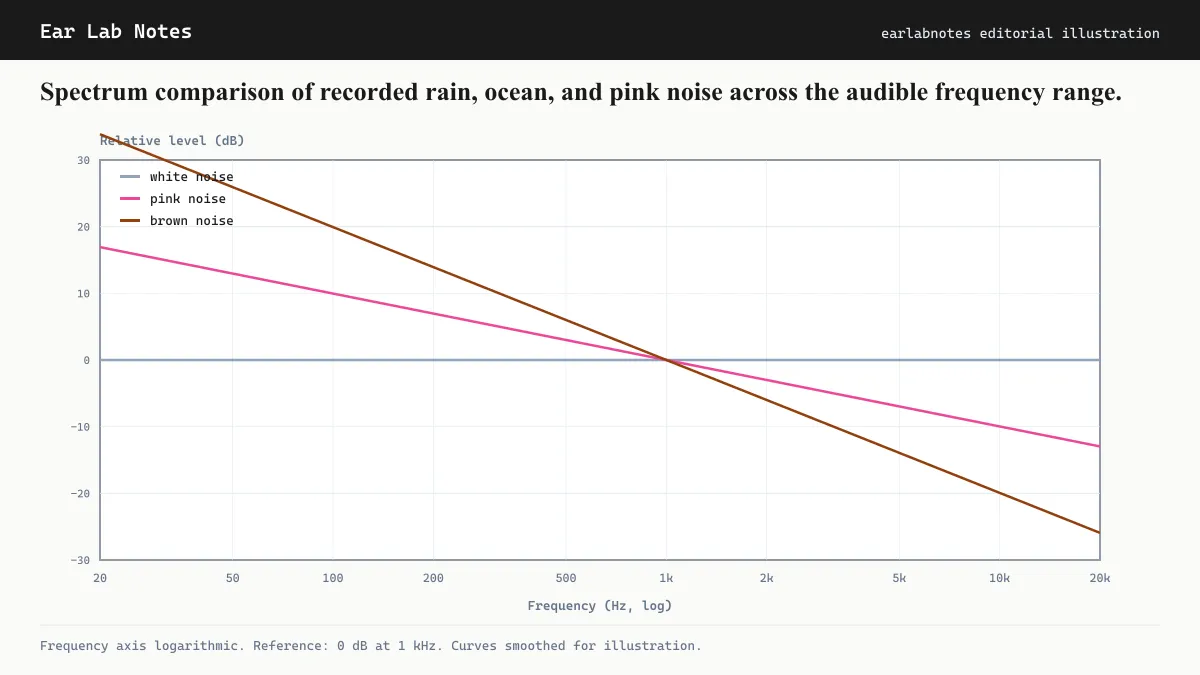
Rainfall, ocean surf, and waterfall recordings all produce energy across a wide range of the audible spectrum. Their spectral shape tends to resemble pink noise: relatively strong at low and mid frequencies, progressively lower energy at higher frequencies. This makes them useful broadband maskers without the sharpness of white noise.
Why nature sounds are preferred over synthetic noise by many people
Natural variation
Synthetic noise such as white or pink noise is, by definition, generated by a fixed statistical process. The resulting sound has no temporal variation beyond random fluctuation. For many people, this sameness becomes noticeable and mildly fatiguing over hours.
Natural recordings contain irregular variation: the rhythm of waves, the changing intensity of rainfall, the random distribution of water drops in a forest. This variation maintains a mild level of unpredictability that appears to prevent the auditory system from fully habituating to the masking sound, which would reduce its effectiveness. Paradoxically, slight irregularity keeps the background from becoming silent to the brain’s pattern-recognition system.
Psychological association
Nature sounds carry associative meaning for most people. Rain, ocean, and forest sounds are associated with calm, rest, and safety in a way that synthetic hiss is not. This association is not medically significant on its own, but it may reduce the stress and anxiety that accompany tinnitus, and both the British Tinnitus Association and NHS UK note that reducing distress is an important part of tinnitus management.
Reduced listener fatigue
The absence of high-frequency harshness in most nature recordings makes them more comfortable for extended listening than white noise. For sleep applications in particular, where the sound may play for six to eight hours, comfort over time is a practical consideration that determines whether the approach is actually used.
Rain sounds: the most commonly used
Rainfall recordings vary considerably. A steady, moderate rain produces relatively continuous sound across a broad frequency range. Heavy rain on a hard surface, a window or metal roof, creates a higher-frequency emphasis. Light rain produces a softer, lower-energy version with more spectral gaps.
For high-pitched tinnitus, a recording of rain on a hard surface tends to provide better spectral coverage of the high-frequency range where most noise-induced tinnitus sits. For lower-pitched tinnitus or when comfort is the primary goal, gentler rain recordings may be sufficient and more pleasant.
Ocean sounds: variable and rhythmic
Ocean recordings introduce rhythmic variation that rain lacks. The cycle of waves approaching and breaking creates a slow amplitude modulation: the sound swells, peaks, then falls, with a rough periodicity that varies with sea conditions.
Some tinnitus sufferers find this rhythmic quality helpful for sleep onset, associating the regular pattern with breathing exercises or relaxation techniques. Others find the variation distracting. Ocean sounds contain a relatively strong low-frequency component from the wave motion, making them spectrally more similar to brown noise than to pink noise.
Waterfall sounds: consistent and broad
Waterfall recordings tend to produce the most consistent broadband masking of the three common nature sounds, because the sound of falling water has fewer temporal fluctuations than rain or ocean surf. Large waterfall recordings are spectrally rich from low bass through high frequencies, providing coverage across a wider tinnitus pitch range.
The consistency can also make waterfall recordings feel monotonous to some listeners over long periods. This is a matter of individual preference rather than a clinical difference in effectiveness.
Forest and birdsong recordings
Beyond rain, ocean, and waterfall, recordings of forest ambient sound, light wind through trees, distant birdsong, and mixed woodland environments have become popular for tinnitus and sleep use. Acoustically, these are more variable than rain or waterfall recordings, with intermittent higher-frequency components from birdsong and lower-frequency background from wind.
For tinnitus masking purposes, forest recordings tend to provide less consistent spectral coverage than more uniform sounds like rainfall. The intermittent silences between bird calls can briefly allow tinnitus to become prominent. However, many people find forest ambient sound less fatiguing than continuous noise for extended listening, particularly during the day when a completely continuous sound may feel intrusive.
Fire and indoor ambient sounds
Some people prefer the crackling sound of a wood fire, indoor ambient sounds from a coffee shop, or similar recordings. These have weaker masking properties than broadband natural sounds because their spectral content is less uniform. They function more as environmental context sounds that reduce the sense of isolation that silence creates, rather than providing acoustic masking in the technical sense.
For people whose tinnitus distress is partly driven by the discomfort of quiet and silence rather than specifically by the loudness of the tinnitus itself, these softer, contextual sounds can be useful additions to a sound enrichment toolkit.
Practical notes for using nature sounds
Volume management is important regardless of the source. The masking sound should be audible and reduce tinnitus prominence without being loud enough to cause its own fatigue or hearing stress. NIOSH guidance suggests keeping continuous sound exposure below 85 dB as a conservative ceiling.
The British Tinnitus Association recommends that masking sounds be used as part of a broader sound enrichment strategy rather than as a standalone fix. The goal is to create an acoustic environment that is neither completely silent, which maximizes tinnitus salience, nor so loud that it becomes fatiguing or adds to overall noise burden.
For people who find it difficult to maintain consistent background sound, devices with built-in nature sound libraries or generative audio that varies without looping can reduce the practical barriers to sustained use. Many smartphones include free nature sound apps, and several audiology-affiliated apps provide more structured delivery of sound enrichment alongside educational content.
Nature sounds work best when used consistently across the times of day when tinnitus is most disruptive, typically evenings and during sleep. Occasional use during periods of acute distress can also provide temporary relief, but the greater benefit comes from consistent acoustic enrichment that gradually shifts the relationship between quiet and tinnitus prominence.
If symptoms persist or change, see an audiologist or physician.
Related notes
Frequently asked
Questions readers ask
- Do nature sounds actually help tinnitus?
- Nature sounds provide masking: they reduce the contrast between the phantom tinnitus signal and the acoustic environment, making tinnitus less noticeable while the sounds are playing. They do not treat or reduce the underlying tinnitus. Many people find them more comfortable than synthetic noise for extended listening, which can make them a practical tool for sleep and relaxation.
- What makes rain sounds good for masking tinnitus?
- Recorded rainfall has a broadly distributed frequency spectrum with energy across a wide range, similar in shape to pink noise. It provides consistent coverage without harshness and includes subtle natural variation that prevents habituation to the masking sound itself. These properties make it suitable as background sound enrichment.
- Is ocean sound the same as white noise?
- Ocean recordings are not the same as white noise. Ocean sounds have a relatively strong low-frequency component from waves and a moderate presence across mid-frequencies. They are spectrally closer to pink or brown noise than to white noise, though they vary considerably depending on the recording environment and wave conditions.
- Can I use nature sounds all night safely?
- At a comfortable volume, nature sounds used for sleep are generally considered safe by audiology guidance. The key is keeping the volume at a level that is easy to hear but not competing to be heard over the tinnitus by being uncomfortably loud. NIOSH recommends staying below 85 dB for any continuous sound exposure.
- Are looped recordings or live streams better for tinnitus?
- Both can work. Some people find that audible loop points in recordings create a brief silence or transition that is noticeable enough to re-attract attention to tinnitus momentarily. Longer loops, generative audio that varies continuously, or live-stream recordings tend to avoid this issue.
Primary sources
Where this comes from
- ◆Tinnitus: Assessment and Management · NIH/NIDCD
- ◆Noise and Hearing Loss Prevention · NIOSH/CDC
- ◆Tinnitus sound therapy · British Tinnitus Association
- ◆Tinnitus: Diagnosis and treatment · Mayo Clinic
- ◆Tinnitus overview · NHS UK
Educational use only.
If your symptoms persist or change, see a licensed audiologist or otolaryngologist. Sudden hearing loss is a medical emergency, see a clinician within 72 hours.
TEL-N023 · The Ear Lab · earlabs.app