
Some medications damage the inner ear as a side effect. This property is called ototoxicity, from the Greek for “ear poison.” Ototoxic drugs can produce tinnitus, hearing loss, or both, and the damage ranges from mild and temporary to severe and permanent depending on the drug class, the dose, the duration of treatment, and individual susceptibility.
NIDCD identifies more than 200 medications known to cause tinnitus or hearing problems. Understanding which drug classes carry this risk, how they act on the ear, and what to watch for can help people and their clinicians make informed decisions about treatment.
Aminoglycoside antibiotics
Aminoglycosides are a class of antibiotics used to treat serious bacterial infections, particularly gram-negative bacteria that are resistant to other agents. Commonly used members of this class include gentamicin, tobramycin, amikacin, and streptomycin.
These drugs are selectively toxic to the outer hair cells of the cochlea. They enter the hair cells through mechanotransduction channels and trigger oxidative damage, particularly in the basal turn of the cochlea, which processes high frequencies. Damage typically begins at frequencies above the speech range and progresses inward with cumulative exposure.
Ototoxicity from aminoglycosides is generally considered irreversible. The risk increases with:
- Higher doses
- Longer treatment duration
- Impaired kidney function (the drugs accumulate when clearance is reduced)
- Concurrent use of other ototoxic agents
- Prior cochlear damage
Because aminoglycosides are often given in hospital settings for life-threatening infections, the risk-benefit calculation frequently favors treatment. Audiological monitoring before, during, and after a course is standard practice when alternatives are unavailable.

Loop diuretics
Loop diuretics, including furosemide (Lasix) and ethacrynic acid, are used to treat conditions including heart failure, kidney disease, and high blood pressure. They act by inhibiting a transport protein in the loop of Henle in the kidney, but the same transport protein is present in the stria vascularis of the cochlea, which regulates the ionic composition of endolymph.
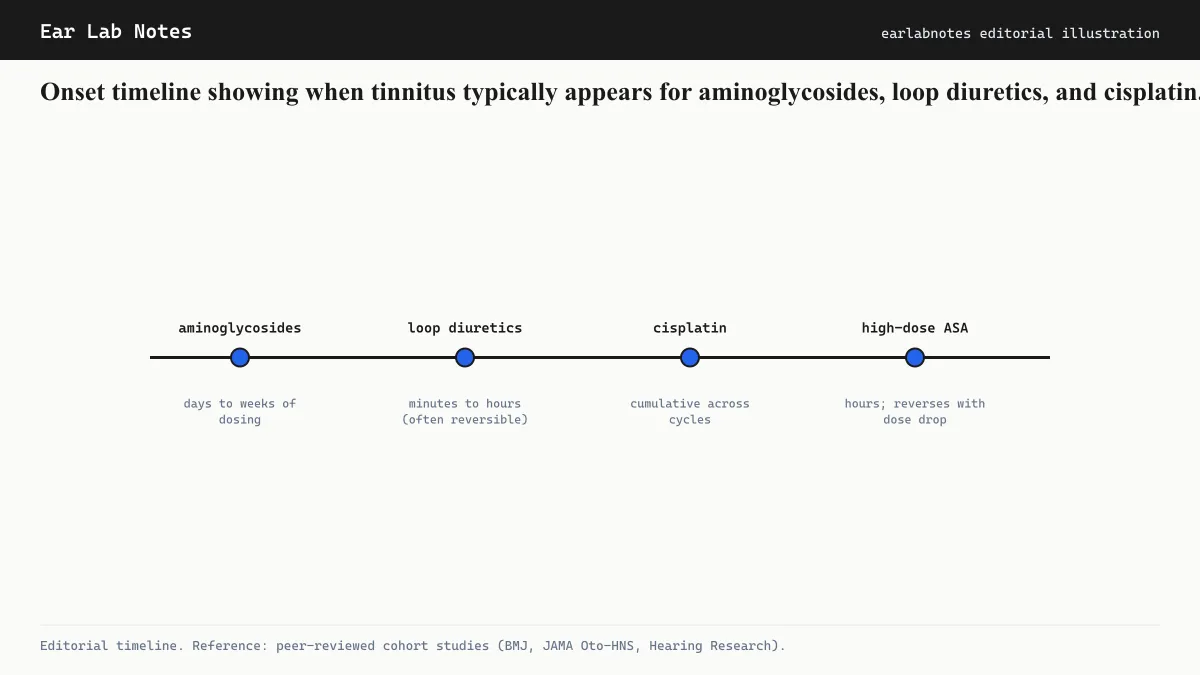
When loop diuretics disrupt endolymph composition, they alter the electrochemical environment hair cells depend on to function. The result can be a rapid-onset tinnitus and hearing reduction, sometimes within minutes to hours of intravenous administration at high doses.
Unlike aminoglycosides, loop-diuretic ototoxicity is usually reversible if the drug is stopped quickly. However, high-dose intravenous furosemide given alongside aminoglycosides substantially increases cochlear risk, and the combination is avoided when possible.
Platinum-based chemotherapy agents
Cisplatin and, to a lesser extent, carboplatin are platinum-based chemotherapy drugs used for a variety of solid tumors. Cisplatin is one of the most widely recognized ototoxins in clinical medicine.
Cisplatin accumulates in the cochlear lateral wall tissue and outer hair cells, generating reactive oxygen species that cause cell death. The pattern of damage resembles noise-induced injury: the basal turn (high-frequency region) is affected first, and loss spreads apically with cumulative doses.
The ototoxicity of cisplatin is dose-dependent and cumulative. Tinnitus may appear during or after treatment. NHS UK and NCI both note that children are especially vulnerable because they have a longer life expectancy over which the hearing loss affects language, learning, and quality of life.
Audiological monitoring during cisplatin therapy is strongly recommended. Where tumor response permits, platinum-sparing regimens or protective agents under investigation may be considered in coordination with the oncology team.
High-dose salicylates (aspirin)
Aspirin (acetylsalicylic acid) at doses used for pain relief in the analgesic range (325 to 650 mg per day) is not typically associated with tinnitus in healthy adults. However, at the high doses historically used to treat rheumatoid arthritis and similar inflammatory conditions (2 to 6 g per day), salicylate ototoxicity becomes a significant concern.
The mechanism involves inhibition of prestin, a motor protein in outer hair cells responsible for electromotility. This reduces the amplification the outer hair cells provide, lowering the cochlea’s sensitivity and generating tinnitus.
Crucially, salicylate-induced tinnitus is generally reversible. NIDCD notes that reducing or discontinuing the high dose typically leads to resolution. This reversibility distinguishes aspirin ototoxicity from that of aminoglycosides and cisplatin. People on chronic high-dose aspirin therapy for medical reasons should discuss any new tinnitus with their prescriber before making changes.
Quinine and antimalarials
Quinine, once widely used for malaria and sometimes used for nocturnal leg cramps, is associated with tinnitus at therapeutic doses. Related compounds, including chloroquine and hydroxychloroquine (used in certain autoimmune conditions), carry ototoxic potential at higher cumulative doses.
Quinine-induced ototoxicity is generally reversible at standard doses but can become permanent with high-dose or long-term exposure. Given that hydroxychloroquine is now prescribed for conditions including lupus and rheumatoid arthritis on a long-term basis, monitoring hearing in patients on chronic therapy is part of standard care guidelines.
Other drug classes associated with ototoxicity
Several other categories appear in the ototoxicity literature at varying levels of evidence:
Tricyclic antidepressants and certain antidepressants: Some case reports link these to tinnitus, though the causal evidence is less robust than for the drug classes above.
Certain NSAIDs: Chronic use of non-aspirin NSAIDs has been associated in observational data with modest increases in hearing risk, though the effect is smaller and less consistent than with salicylates.
Vancomycin: This glycopeptide antibiotic, used for serious gram-positive infections, is associated with ototoxicity, particularly when combined with aminoglycosides or when blood levels are not carefully monitored.
Risk factors that increase susceptibility
Not everyone exposed to ototoxic drugs develops tinnitus or hearing loss. Individual susceptibility varies and is influenced by:
- Pre-existing cochlear damage from noise or aging
- Renal function (affects drug clearance and accumulation)
- Genetic variants in drug-metabolism and cochlear-transport genes
- Cumulative dose and treatment duration
- Combined use of multiple ototoxic agents
What to discuss with a prescriber
If a prescribed medication is from an ototoxic class, discussing the following with the prescribing clinician is reasonable:
Whether audiological baseline testing before treatment is appropriate, what symptoms (new tinnitus, sudden change in hearing clarity, vertigo) should prompt immediate contact, and whether alternative drugs with less ototoxic potential exist for the indication.
The decision to use an ototoxic medication is almost always made because the clinical benefit outweighs the risk. The goal of awareness is to enable monitoring and early detection rather than to discourage necessary treatment.
If symptoms persist or change, see an audiologist or physician.
Related notes
Frequently asked
Questions readers ask
- If I notice ringing after starting a new medication, what should I do?
- Report it to your prescriber promptly. Do not stop a prescribed medication without medical guidance, because for some conditions (such as serious infection) stopping treatment carries its own risks. Your doctor can assess whether an alternative exists and weigh the options with you.
- Is aspirin-related tinnitus permanent?
- Tinnitus from high-dose aspirin is generally considered reversible once the dose is reduced or stopped, according to NIDCD. This distinguishes it from aminoglycosides and cisplatin, where damage can persist. However, every case is individual, and a clinician should be involved in any decision to change dosing.
- Are over-the-counter pain relievers ototoxic?
- Standard therapeutic doses of acetaminophen, ibuprofen, and naproxen are not strongly linked to ototoxicity. Chronic high-dose NSAID use is associated with some hearing risk in observational studies, but the effect size is modest compared to aminoglycosides or cisplatin. Aspirin is the NSAID with the strongest and best-characterized dose-dependent ototoxic effect.
- Can I tell if a medication is ototoxic before taking it?
- The prescribing information (package insert) for most ototoxic drugs includes hearing and tinnitus as listed adverse effects. Your pharmacist can also review your medication list for known ototoxic agents. Audiological monitoring before, during, and after treatment is standard practice for cisplatin and aminoglycoside courses when alternatives are not available.
Primary sources
Where this comes from
- ◆Tinnitus - NIDCD · National Institute on Deafness and Other Communication Disorders
- ◆Ototoxicity - National Cancer Institute · National Cancer Institute, NIH
- ◆Clinical Practice Guideline: Tinnitus - AAO-HNS · American Academy of Otolaryngology, Head and Neck Surgery
- ◆Tinnitus - NHS · NHS UK
Educational use only.
If your symptoms persist or change, see a licensed audiologist or otolaryngologist. Sudden hearing loss is a medical emergency, see a clinician within 72 hours.
TEL-N026 · The Ear Lab · earlabs.app