What noise color means
Sound can be characterized by how its energy is distributed across the frequency spectrum. When energy is distributed equally across all frequencies, the result is white noise: a hissing, uniform sound that contains the full range from low bass to high treble in equal measure.
Colored noises shift that energy distribution. The metaphor borrows from physics: just as colored light emphasizes certain wavelengths, colored noise emphasizes certain frequency ranges, changing the perceived character of the sound.
The three colors most commonly discussed for tinnitus and sleep are white, pink, and brown.
White noise: uniform and bright
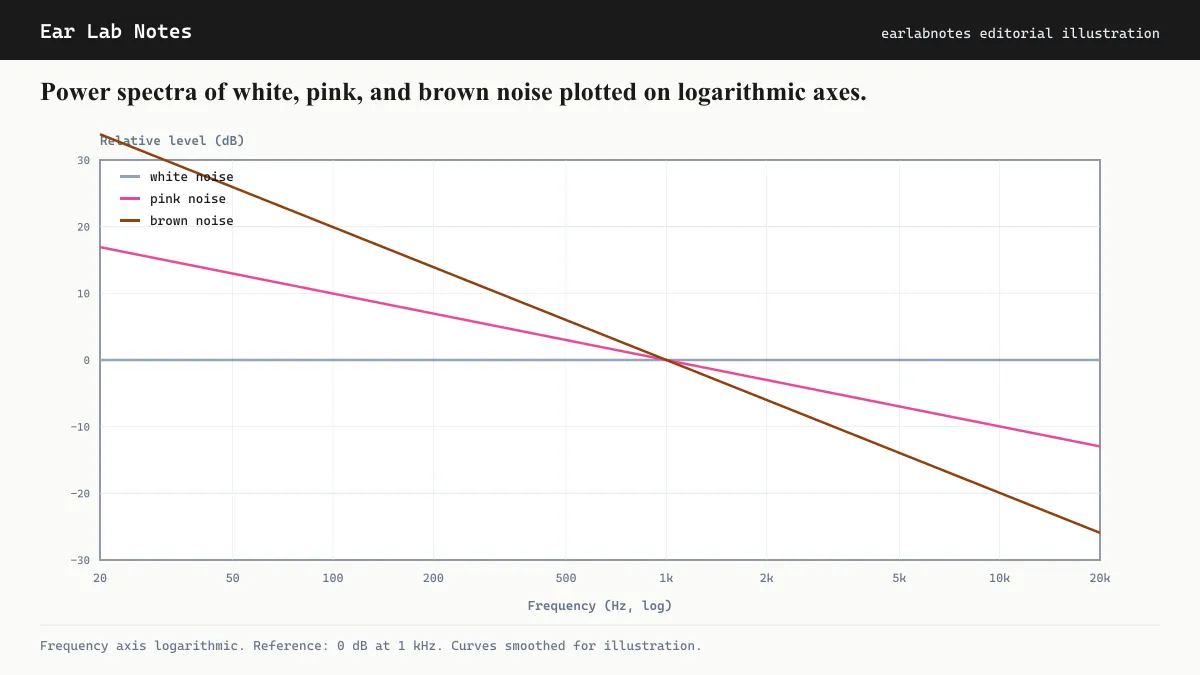
White noise contains equal energy at every frequency across the audible range, roughly 20 Hz to 20,000 Hz. Because the ear is more sensitive to higher frequencies, and because higher frequency bands contain more individual frequency components in the same octave span, white noise sounds relatively bright or harsh to most people.
It is the classic masking sound: comprehensive, somewhat clinical, and effective at covering a wide range of tinnitus pitches simultaneously. Many traditional noise machines and apps default to white noise, partly because it is easiest to generate and understand.
For tinnitus masking purposes, white noise’s high-frequency content makes it particularly useful for masking the high-pitched ringing, typically 4 to 8 kHz, that is the most common pattern in noise-induced tinnitus.
Pink noise: the octave-equal option
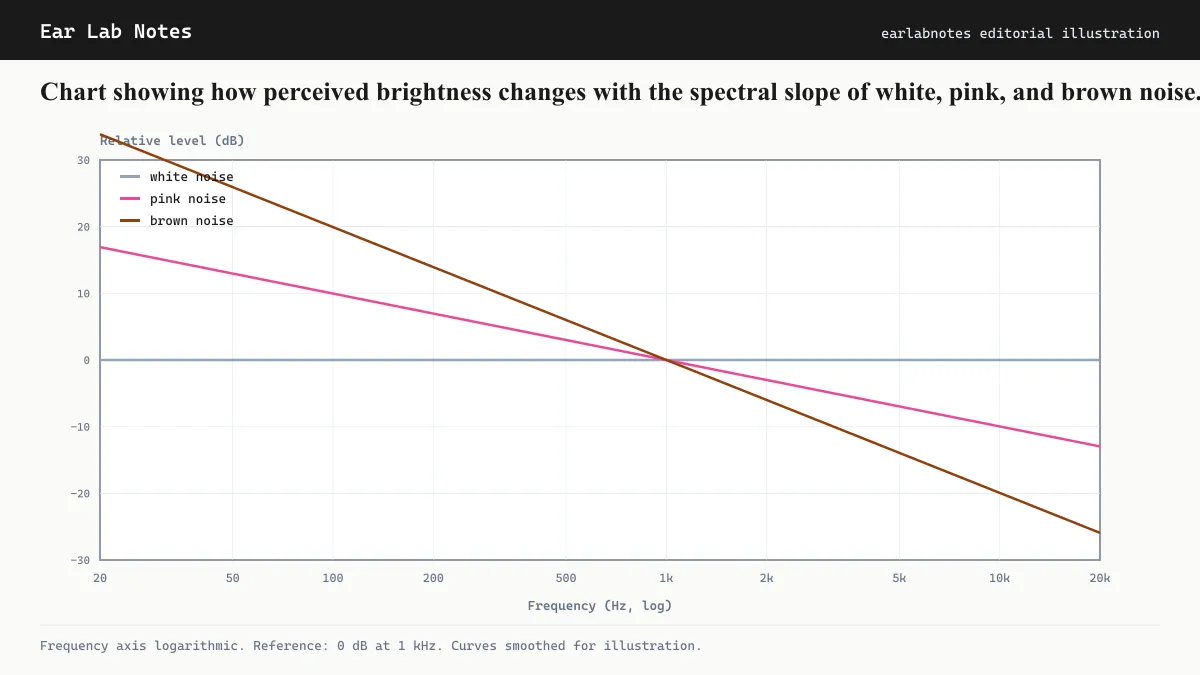
Pink noise reduces energy by approximately 3 decibels per octave as frequency increases. This compensates for the perceptual imbalance of white noise, producing a sound where each octave band contributes equally to the perceived loudness.
To human ears, pink noise sounds softer, smoother, and more natural than white. Many people describe it as resembling steady rainfall or a waterfall heard from some distance. Its frequency distribution actually approximates many natural sounds, which may explain why it tends to be found more pleasant for extended listening.
For sleep use, pink noise is often preferred over white precisely because its reduced high-frequency content is less tiring over hours. Some research into sleep quality has used pink noise as the test stimulus, and results have generally been favorable for sleep onset and continuity, though the evidence base is modest.
For tinnitus masking, pink noise covers most of the range where common tinnitus pitches fall while being gentler to the ear over extended periods.
Brown noise: deep and rumbling
Brown noise (also called red noise) reduces energy by approximately 6 decibels per octave. The result is a sound heavily weighted toward low frequencies: a deep rumble, sometimes compared to the sound of a large river, strong wind, or a distant engine.
Brown noise contains relatively little high-frequency energy. This makes it less effective as a broadband masker for high-pitched tinnitus, since the frequencies of the masking sound and the phantom sound do not overlap much. However, for people with lower-pitched tinnitus, a humming or roaring quality sometimes associated with Meniere’s disease or vascular causes, brown noise may provide better spectral matching.
Brown noise has gained significant popular attention on social media in recent years, with many users reporting that it helps concentration or reduces anxiety. The research base for these specific claims is limited, and clinical tinnitus guidelines from bodies including the AAO-HNS do not distinguish between noise colors in their recommendations.
How masking actually works
Masking refers to the perceptual phenomenon in which one sound makes another harder to detect. The mechanism relies on the auditory system’s finite processing capacity: when a broadband masking sound is introduced, it partially occupies the same frequency channels as the tinnitus signal, reducing the contrast between the phantom sound and the acoustic background.
Crucially, masking does not treat tinnitus or produce any lasting change in the underlying phantom signal. When the masking sound is turned off, tinnitus returns. The goal is perceptual relief during the masking period, and in the context of sleep or relaxation, that is a meaningful clinical benefit.
The level of the masking sound matters. NIOSH guidelines recommend that continuous sound exposure remain below 85 dB to avoid contributing to noise-induced damage over time. For masking purposes, the sound generally needs to be only as loud as is comfortable, not louder than the tinnitus.
What the tinnitus literature says about noise color preference
Published clinical guidelines for tinnitus, including those from NIH/NIDCD and the AAO-HNS, discuss sound therapy broadly rather than prescribing a specific noise color. The rationale is that individual preference, tinnitus characteristics, and context all influence which sound is most useful for a given person.
In practice, audiologists working with tinnitus often encourage patients to try different sounds and choose based on comfort and perceived effectiveness. There is no clinical consensus that one noise color outperforms another for tinnitus relief at the population level.
Other colors of noise
Beyond white, pink, and brown, marketing materials for sleep and tinnitus products sometimes mention grey noise, blue noise, violet noise, and green noise. These are real acoustic classifications, but they have negligible clinical trial data associated with them in the context of tinnitus.
Grey noise is spectrally shaped to match the equal-loudness contours of human hearing, which theoretically makes it sound equally loud across all frequencies. Blue and violet noise have increasing high-frequency energy, making them even brighter than white noise. These have not been studied specifically for tinnitus and are not referenced in clinical guidelines from NIH/NIDCD, the AAO-HNS, or the British Tinnitus Association.
The volume question
Volume selection matters significantly with all colored noises. The goal of sound enrichment is not to drown out tinnitus but to reduce the contrast between the phantom sound and the background acoustic environment. This can often be achieved at volumes well below maximum.
NIOSH’s occupational noise exposure guidance recommends limiting continuous sound exposure below 85 dB at the ear. Consumer device volume controls are not calibrated to absolute dB levels, so there is no single volume setting that guarantees safe exposure. A practical heuristic: the masking sound should be audible and reducing tinnitus salience, but not so loud that you would struggle to hold a conversation at normal speaking volume with it running.
Using earphones for extended masking, as opposed to a desktop or bedside machine, increases the delivered sound level relative to the same apparent volume setting. Keeping earphone volume conservative is particularly important for extended overnight or all-day use.
Practical guidance for choosing
A few considerations can help narrow the choice:
If the tinnitus is high-pitched, a hiss or whistle, white or pink noise tends to provide better spectral overlap with the phantom sound and therefore better masking.
If the tinnitus is low-pitched, a hum, roar, or drone, brown noise or sounds with stronger low-frequency content may match more closely.
For sleep use, comfort over hours matters more than masking precision. Pink or brown noise are generally found more pleasant for extended listening than white.
For concentration during work, the specific color may matter less than the presence of a consistent background that prevents sudden environmental sounds from triggering attention shifts.
No noise color has been shown to produce lasting tinnitus relief independent of the masking period. Combining sound enrichment with psychological support or habituation-based therapy tends to produce more durable improvements.
If symptoms persist or change, see an audiologist or physician.
Related notes
Watch
Human ear: structure and working
Source: Khan Academy on YouTube
Transcript / summary
Frequently asked
Questions readers ask
- What does noise color actually mean?
- Noise color is an informal analogy to light spectra. White light contains all visible wavelengths equally; white noise contains all audible frequencies at equal energy. Colored noises have more or less energy at different parts of the spectrum, producing characteristic sonic characters: bright, smooth, or deep.
- Which noise color is best for tinnitus?
- There is no single answer supported by clinical evidence. People with high-pitched tinnitus sometimes find that white or pink noise, which contain more high-frequency energy, provide better masking. People with lower-pitched or rumbling tinnitus may prefer brown noise. Personal preference and comfort are legitimate guides when the evidence for superiority of any one color is limited.
- Is it safe to sleep with a noise machine running all night?
- At moderate volumes, broadband noise is generally considered safe for sleep use by audiological guidance. Volume is important: the sound should be comfortable, not competing to be heard over tinnitus at a high level. NIOSH recommends keeping any continuous sound below 85 dB to avoid long-term hearing damage.
- What is brown noise, and why do some people call it red noise?
- Brown noise is named after Robert Brown, who described Brownian motion, the random movement pattern that its mathematical structure resembles. It is also called red noise by analogy with red light, which has lower frequency than white light. The sound is deeper and more rumbling than pink noise.
- Can noise machines cure tinnitus?
- No noise machine cures tinnitus. Masking sounds change the perceptual context in which tinnitus is heard, making the phantom sound less noticeable while the masking sound is playing. Tinnitus typically returns to its usual prominence when the masking sound is removed.
Primary sources
Where this comes from
- ◆Tinnitus: Assessment and Management · NIH/NIDCD
- ◆Noise and Hearing Loss Prevention · NIOSH/CDC
- ◆Tinnitus Clinical Practice Guideline · AAO-HNS
- ◆Tinnitus overview · British Tinnitus Association
- ◆Tinnitus: Diagnosis and treatment · Mayo Clinic
Educational use only.
If your symptoms persist or change, see a licensed audiologist or otolaryngologist. Sudden hearing loss is a medical emergency, see a clinician within 72 hours.
TEL-N028 · The Ear Lab · earlabs.app