Advice about sodium and tinnitus is one of the most frequently misapplied pieces of dietary guidance in this area. The link between salt and tinnitus is real, but it applies specifically to one condition: Meniere’s disease. Generalizing this advice to all forms of tinnitus is not supported by evidence.
Why sodium matters for Meniere’s disease
Meniere’s disease is a condition of the inner ear characterized by episodes of vertigo, fluctuating low-frequency hearing loss, a sense of ear fullness, and tinnitus that typically has a low-pitched roaring quality. The underlying structural change is endolymphatic hydrops: an excess of fluid pressure in the endolymph compartment of the cochlea and vestibular apparatus.
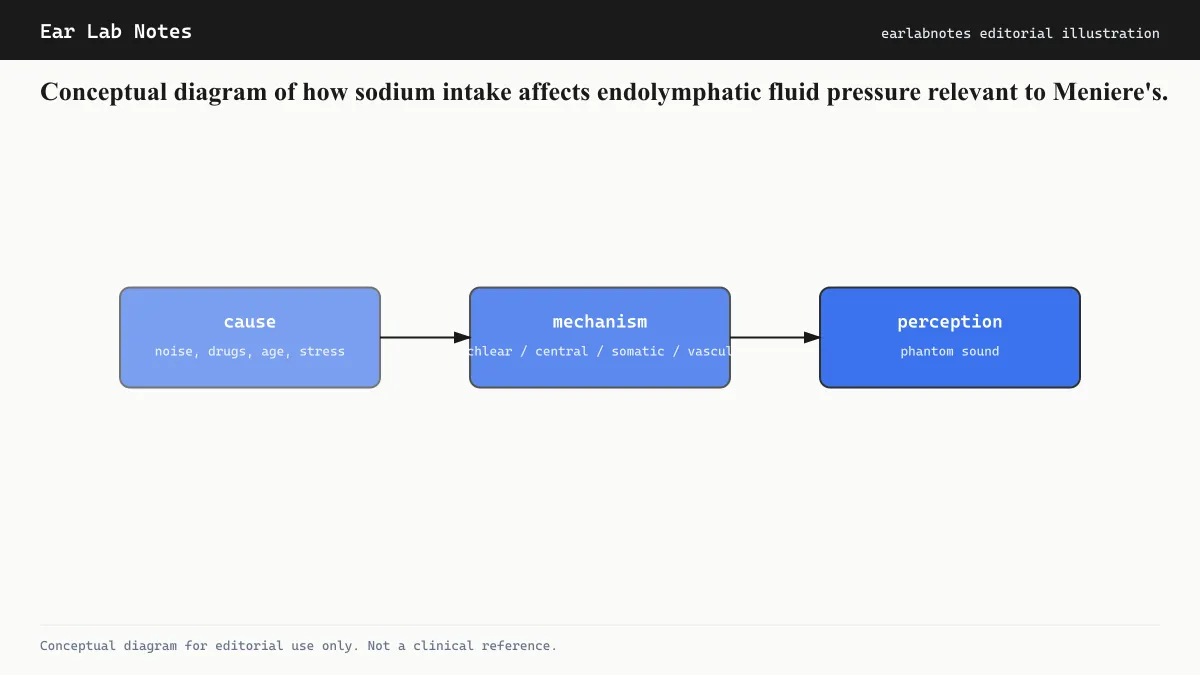
Sodium plays a role in fluid balance throughout the body, including in the inner ear. Higher dietary sodium leads to greater fluid retention. In the context of the inner ear, this is thought to worsen endolymphatic pressure, which can trigger Meniere’s episodes.
The rationale for low-sodium diet in Meniere’s disease is therefore mechanistically grounded. The AAO-HNS clinical practice guideline for Meniere’s disease recommends dietary sodium restriction as part of initial management, typically aiming for around 2,000 mg of sodium per day, which is meaningfully lower than the average dietary intake in most Western countries.
What the evidence for Meniere’s actually shows
The evidence for sodium restriction in Meniere’s disease is clinically accepted but not based on large randomized controlled trials. Most of the supporting evidence comes from clinical experience, retrospective series, and mechanistic plausibility. There is no simple way to blind a dietary study, which limits the strength of available trials.
Despite these limitations, sodium restriction is standard practice in Meniere’s management and is recommended by both NIDCD and Mayo Clinic resources, as well as the AAO-HNS guideline. The potential benefit is meaningful and the risk of reducing sodium to moderate levels is low for most healthy adults.
For tinnitus without Meniere’s disease
The majority of people with tinnitus have it from other causes, primarily noise-induced hearing loss, age-related hearing loss (presbycusis), or a combination of the two. Neither of these involves endolymphatic hydrops.
For these cases, there is no established mechanistic reason why dietary sodium would significantly affect tinnitus. The inner ear’s fluid compartments in noise-induced or age-related tinnitus are not distended in the same way. Reducing salt does not address the cochlear hair cell damage or the central-gain changes that underlie the phantom sound.
Neither NIDCD nor the AAO-HNS tinnitus guideline lists sodium restriction as a general recommendation for tinnitus management outside of the Meniere’s context.
Common sources of dietary sodium
For anyone managing Meniere’s disease and trying to reduce sodium, knowing where dietary sodium actually comes from is practical. In most Western diets, the majority of sodium comes from processed and packaged foods rather than table salt added during cooking. Bread, canned soups, deli meats, condiments, and restaurant meals typically contain more sodium per serving than home-cooked food.
Reading nutrition labels and choosing lower-sodium versions of commonly consumed products has more impact than simply removing the saltshaker from the table.
Consistent intake versus spikes
Meniere’s disease management guidance from Mayo Clinic and specialist practice often emphasizes consistency of sodium intake as much as the absolute level. Large day-to-day swings in sodium can produce corresponding changes in fluid balance and potentially precipitate episodes. Eating roughly the same sodium level each day is as important as the target level itself.
The hydration question
Alongside sodium restriction, Meniere’s disease management frequently includes advice about consistent daily hydration. The aim is to maintain stable fluid balance rather than creating the large oscillations that come from not drinking throughout the day and then consuming large amounts at once.
This is different from the broader and poorly supported claim that dehydration causes tinnitus in general, which circulates in wellness content without a strong evidence basis for tinnitus from non-Meniere’s causes.
Summary
Salt restriction and tinnitus are directly linked for Meniere’s disease, where the connection is mechanistically grounded and clinically accepted. For other forms of tinnitus, the evidence for dietary sodium reduction as a management strategy is weak. The NHS notes that there is currently no scientifically proven cure for tinnitus and that management focuses on making symptoms more tolerable, which for most forms means sound therapy, counseling, and behavioral approaches rather than dietary restriction.
If symptoms persist or change, see an audiologist or physician.
Related notes
Frequently asked
Questions readers ask
- Does reducing salt help tinnitus for everyone?
- No. Dietary sodium restriction has a clear rationale for Meniere's disease, where endolymphatic hydrops is the underlying mechanism. For tinnitus from noise damage, age-related hearing loss, or other causes, the evidence for salt restriction is much weaker.
- How much sodium do Meniere's disease guidelines recommend?
- AAO-HNS guidelines and specialist practice typically recommend limiting sodium to around 2,000 mg per day for Meniere's disease. This is lower than average consumption in most Western countries. Specific dietary guidance should come from the treating clinician.
- What is endolymphatic hydrops?
- Endolymphatic hydrops is an increase in fluid pressure within the endolymph compartment of the inner ear. It is the structural change associated with Meniere's disease and is thought to cause the fluctuating hearing loss, tinnitus, and vertigo episodes that characterize the condition.
- If I cut salt drastically, will my tinnitus improve quickly?
- For Meniere's disease, dietary changes typically need several weeks to show effect, and the response varies between individuals. Abrupt extreme dietary restriction is not necessary and can cause its own problems. Any significant dietary change should be discussed with a physician.
- Does water intake matter alongside sodium?
- For Meniere's disease management, consistent hydration throughout the day is often recommended alongside sodium restriction, as large swings in fluid intake can affect endolymphatic pressure. For tinnitus without Meniere's, the evidence for this is more limited.
Primary sources
Where this comes from
- ◆Meniere's Disease · National Institute on Deafness and Other Communication Disorders (NIDCD)
- ◆Meniere's Disease · Mayo Clinic
- ◆Clinical Practice Guideline: Meniere's Disease · American Academy of Otolaryngology-Head and Neck Surgery (AAO-HNS)
- ◆Meniere's Disease · NHS UK
Educational use only.
If your symptoms persist or change, see a licensed audiologist or otolaryngologist. Sudden hearing loss is a medical emergency, see a clinician within 72 hours.
TEL-N030 · The Ear Lab · earlabs.app