One bad night, a louder morning
People with tinnitus commonly report that after sleeping poorly, the ringing seems more prominent the next day. This is not imagined. Sleep deprivation reduces the brain’s capacity to filter out repetitive, non-threatening signals, and tinnitus fits exactly that description: a repetitive signal the auditory system is normally working to push into the background.
The connection runs in both directions. Poor sleep raises tinnitus salience. Salient tinnitus disrupts sleep. The result is a bidirectional loop that can sustain itself long after the original poor night.
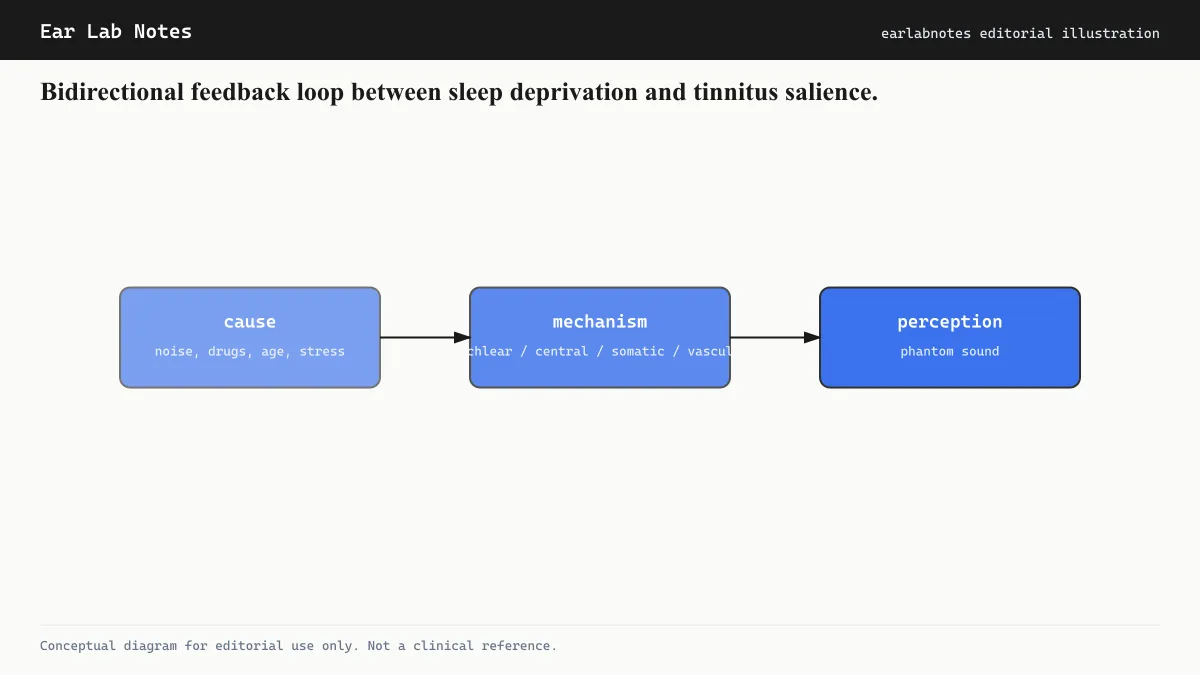
Why sleep affects tinnitus perception
During sleep, the brain consolidates information and regulates emotional processing. One structure central to this process is the amygdala, which governs threat responses. When sleep is cut short or fragmented, the amygdala becomes more reactive, treating borderline signals as more threatening than it would after adequate rest.
Tinnitus lives at the border between signal and noise. An adequately rested brain classifies it as non-threatening and reduces its priority. A sleep-deprived brain is more likely to keep it elevated in the attentional hierarchy, which is experienced as louder or more intrusive ringing.
NIDCD materials on tinnitus management identify this emotional-regulation pathway as part of why sleep and tinnitus interact so closely, and why interventions targeting emotional reactivity, such as cognitive behavioral therapy, often address sleep alongside tinnitus distress.
The quietest room problem
Tinnitus is rarely the loudest thing in a waking environment. During the day, competing sounds, conversations, traffic, music, background activity, all attract attention that might otherwise go to the ringing. At night, those competing signals disappear. The result is that tinnitus, unchanged in its underlying intensity, has the acoustic field almost entirely to itself.
Silence also removes the distraction that suppresses tinnitus awareness during daylight hours. Without cognitive engagement, the attentional spotlight moves freely, and for many people it gravitates toward the most unusual signal in the environment. Tinnitus qualifies.
This is why many clinicians and the British Tinnitus Association recommend some form of low-level background sound during sleep rather than complete silence. A fan, a sound machine, or quiet music can raise the ambient noise floor enough to reduce the contrast between tinnitus and the environment.
Cortisol and the morning amplification effect
Sleep deprivation elevates cortisol, the primary stress hormone. Cortisol affects vascular tone, including blood flow to the cochlea and brainstem. These physiological changes do not damage hearing in the short term, but they alter the baseline state of the auditory system, potentially contributing to the perception of louder tinnitus in the morning after a poor night.
The cortisol link also connects sleep to the broader stress-tinnitus relationship. Both mechanisms, emotional reactivity and elevated cortisol, converge to make the auditory system more reactive to internal signals on days following poor sleep.
Small habits with large leverage
Most sleep interventions discussed in tinnitus-related clinical education are behavioral rather than pharmaceutical. Among the habits that clinical guidance consistently highlights:
Consistent wake time. Getting up at the same time each day, regardless of how well the previous night went, helps anchor the circadian rhythm. This tends to produce more consistent sleep quality over time than trying to compensate for bad nights with late rising.
Reducing screen exposure before bed. Blue-spectrum light from screens delays melatonin release. Melatonin is not a tinnitus treatment, but adequate melatonin production is part of normal sleep architecture.
Keeping the sleep environment acoustically neutral rather than silent. A broadband background sound, such as a fan or pink noise machine, can mask tinnitus enough to reduce the number of arousal events during the night. The British Tinnitus Association discusses this approach in its patient education materials.
Avoiding long daytime naps. A nap of more than 20 to 30 minutes can fragment nighttime sleep pressure, making it harder to fall and stay asleep.
Addressing rumination directly. Anxious thinking about tinnitus at bedtime is a significant driver of sleep-onset insomnia for people with chronic tinnitus. Writing down concerns earlier in the evening rather than ruminating in bed is a behavioral technique with support from CBT literature.
What the evidence does and does not say
The link between sleep deprivation and worsened tinnitus perception is well-described in patient reports and consistent with what is known about sleep and auditory processing. Controlled studies isolating the effect are fewer than one might expect, partly because it is methodologically difficult to manipulate sleep deprivation in ways that are safe and ethical.
The AAO-HNS clinical practice guideline for tinnitus does not recommend any specific sleep aid for tinnitus but does list sleep quality as an important consideration in the overall management of bothersome tinnitus. That is consistent with the evidence: sleep is one component of a multi-factor picture rather than a magic lever.
When to discuss sleep with a clinician
Persistent sleep difficulty, meaning difficulty falling asleep, staying asleep, or waking too early more nights than not for several weeks, warrants a conversation with a physician or specialist. Several conditions that are both treatable and relevant to tinnitus, including sleep apnea, can disrupt sleep architecture without the person being aware of the disruption.
If symptoms persist or change, see an audiologist or physician.
Related notes
Frequently asked
Questions readers ask
- Does lack of sleep make tinnitus louder?
- Many people with tinnitus report that their ringing seems louder or more intrusive after a poor night's sleep. Research on fatigue and auditory perception suggests that sleep deprivation reduces the brain's ability to filter background signals, which can make tinnitus more salient even if its underlying intensity has not changed.
- Why is tinnitus worse at night?
- At night, external sounds that normally compete with tinnitus for attention disappear. The resulting quiet makes the phantom sound more prominent. Additionally, lying awake with nothing else to focus on directs attention toward the ringing, which the brain then treats as more significant.
- Can improving sleep reduce tinnitus distress?
- Clinical guidelines from organizations including the British Tinnitus Association list sleep hygiene as one of the foundations of tinnitus management. Better sleep appears to lower the reactivity of the limbic system to the tinnitus signal, which reduces how bothersome it feels during waking hours.
- Should I use sleeping pills if tinnitus is keeping me awake?
- That is a question for a physician. Some sedatives can affect auditory processing and some have interactions worth discussing with a prescriber. Sleep hygiene and behavioral approaches are typically considered before medication for tinnitus-related insomnia.
Primary sources
Where this comes from
- ◆Tinnitus: Overview and Management · NIH/NIDCD
- ◆Sleep and Tinnitus · British Tinnitus Association
- ◆Tinnitus: Diagnosis and Management · Mayo Clinic
- ◆Clinical Practice Guideline: Tinnitus · AAO-HNS
Educational use only.
If your symptoms persist or change, see a licensed audiologist or otolaryngologist. Sudden hearing loss is a medical emergency, see a clinician within 72 hours.
TEL-N031 · The Ear Lab · earlabs.app