Why stress and tinnitus are connected
Tinnitus is a phantom sound, a signal the brain generates rather than one arriving from outside. Stress does not add new signals to the auditory system, but it changes how the brain prioritizes the signals already there. That distinction matters because it shapes realistic expectations: stress management cannot silence tinnitus, but it can reduce how much tinnitus dominates attention.
The mechanism researchers point to most often is the limbic-auditory connection. The limbic system, which includes structures like the amygdala, governs emotional responses and threat detection. When stress levels rise, the amygdala sends signals that raise the brain’s overall vigilance. For people with tinnitus, that heightened vigilance often includes greater attention to the phantom sound.
The limbic-auditory loop
The term “limbic-auditory loop” describes the two-way communication between emotional-processing circuits and auditory-processing circuits in the brain. Under normal conditions, the auditory cortex learns to filter out repetitive, non-threatening sounds. Traffic noise, air conditioning hum, and, in theory, tinnitus are candidates for this filtering process.
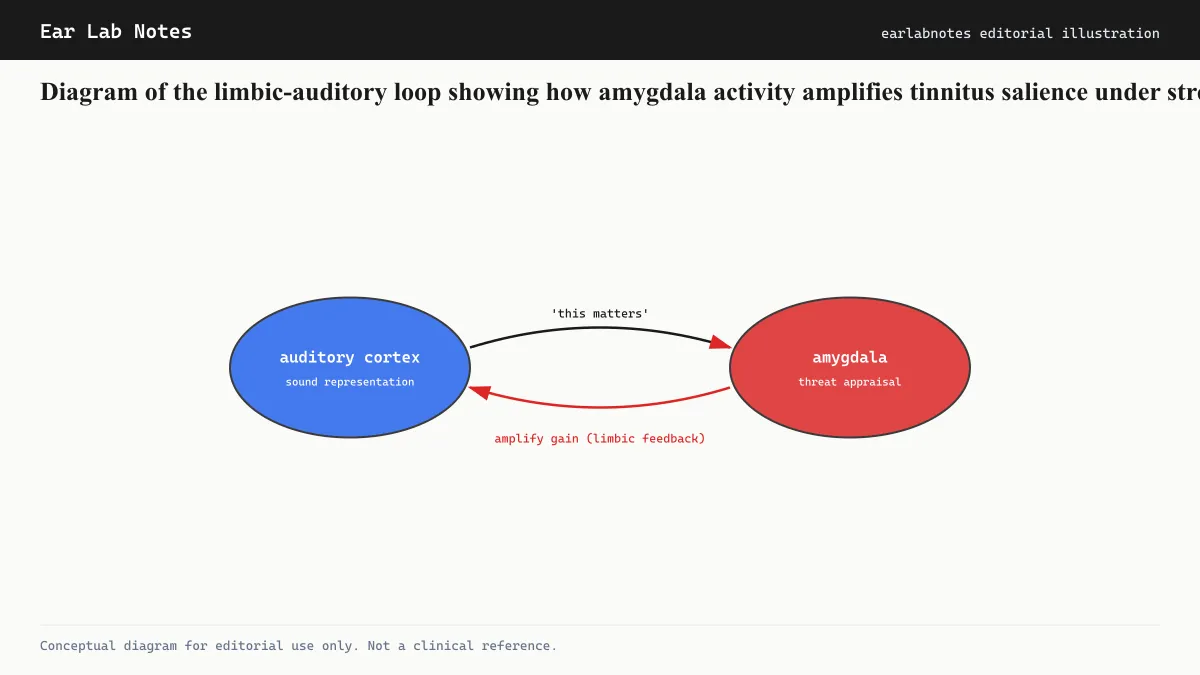
The filtering process is called habituation. When stress is low and the limbic system is calm, habituation proceeds more readily. The brain classifies the tinnitus signal as benign and stops giving it priority.
When stress is high, the limbic system intervenes. Because the amygdala is treating the environment as potentially threatening, it actively resists filtering sounds that might be warning signals. Tinnitus, which is already an unusual internal signal, becomes harder to habituate. The loop reinforces itself: noticing tinnitus more creates worry, worry raises stress, and raised stress makes the tinnitus more salient again.
Researchers at institutions including NIDCD have noted this feedback dynamic as central to why tinnitus distress varies so much from day to day even when audiometric measures of the sound remain stable.
What stress hormones do to the auditory system
Cortisol and adrenaline, released during the stress response, have direct effects on the body that can compound tinnitus perception. Cortisol influences blood flow, including circulation to the cochlea and auditory brainstem. In the short term, these changes are unlikely to damage hearing, but they alter the physiological baseline against which the auditory system operates.
Some researchers also note that the stress response increases muscle tension. In people who have somatic tinnitus, where tinnitus is partially driven by muscle and joint inputs rather than purely cochlear signals, elevated tension in the neck, jaw, or shoulders can modulate the ringing.
The attention channel
A separate but related mechanism involves selective attention. Research on cognitive load and tinnitus has found that when people are mentally engaged in demanding tasks, tinnitus often recedes into the background. When they are idle, anxious, or fatigued, it steps forward.
Stress tends to fragment attention, making sustained focus harder. That fragmentation can create more opportunities for tinnitus to capture attention, particularly in quiet environments at night, which is why many people report their worst tinnitus moments coinciding with stressful periods.
The British Tinnitus Association’s educational materials describe this as tinnitus using the “attentional spotlight.” The sound is constant, but the spotlight moves. Stress repositions it toward the tinnitus more often.
Psychological interventions and the evidence base
Cognitive behavioral therapy is the intervention with the strongest evidence base for tinnitus distress, according to a 2014 clinical practice guideline from the American Academy of Otolaryngology-Head and Neck Surgery (AAO-HNS). CBT does not target the tinnitus signal itself. Instead, it works with the appraisal of the signal, helping people develop more neutral responses so the limbic system stops classifying tinnitus as a threat.
Mindfulness-based stress reduction, originally developed for chronic pain, has been studied in tinnitus populations. Controlled trials suggest modest improvements in distress rather than loudness. The mechanism appears to be the same as with CBT: reducing the emotional charge the brain attaches to the sound.
What about relaxation techniques?
Progressive muscle relaxation, diaphragmatic breathing, and similar techniques reduce physiological arousal. Whether they measurably change tinnitus in controlled conditions is less clear than their effect on general anxiety. As a class of intervention, they are low-risk and may help as part of a broader stress-management approach rather than as standalone tinnitus treatments.
Sleep is the third element
Stress, tinnitus, and sleep form a three-way relationship. Poor sleep elevates cortisol levels, increasing physiological stress. Stress makes tinnitus more salient. Salient tinnitus disrupts sleep. Each component of the loop feeds the others.
Managing stress as one part of a broader approach that includes sleep hygiene has more practical support than addressing any single element in isolation. NIDCD materials on tinnitus management consistently list stress reduction alongside sound therapy and hearing evaluation as the pillars of conservative care.
Prevalence context
The NIH/NIDCD estimates that approximately 10 to 15 percent of U.S. adults experience tinnitus to some degree. Among people who describe tinnitus as bothersome, high-stress periods are one of the most commonly reported triggers for exacerbations. This does not mean stress causes the underlying condition, but it confirms the practical relevance of the limbic-auditory connection at a population level.
What the evidence does not support
Several claims circulate about stress and tinnitus that go beyond what the evidence supports. These include:
- Specific diets eliminating stress-induced tinnitus
- Supplements reliably lowering stress-tinnitus links through physiological action
- Single-session interventions permanently breaking the limbic-auditory loop
The current evidence does not support any of these at a standard required for clinical endorsement. Improvements from stress management tend to be gradual and vary considerably between individuals.
Practical takeaways without prescribing treatment
Understanding the limbic-auditory loop has practical value even without a clinical protocol. Knowing that tinnitus salience rises and falls with emotional state rather than reflecting an underlying worsening of the ear’s condition can reduce catastrophic thinking. Catastrophic thinking is itself a source of limbic activation, so a more accurate mental model of what is happening can interrupt the loop at the cognitive level.
This is one reason the AAO-HNS guideline recommends patient education as an explicit step in tinnitus management, independent of any specific therapeutic technique.
If symptoms persist or change, see an audiologist or physician.
Related notes
Frequently asked
Questions readers ask
- Does stress cause tinnitus?
- Stress does not typically create tinnitus where none existed before. However, research suggests that the limbic system's response to stress raises the brain's overall arousal level, making existing phantom sound more noticeable and harder to ignore.
- Why does my tinnitus seem louder when I am anxious?
- Anxiety triggers the amygdala, which increases general threat-monitoring. The auditory system becomes more vigilant, and tinnitus, which already competes for attention, gets amplified in perceived loudness even though its physical signal has not changed.
- Can reducing stress actually make tinnitus quieter?
- Studies on cognitive behavioral therapy and mindfulness-based approaches suggest that lowering stress and emotional reactivity reduces how bothersome tinnitus feels. Whether the perceived pitch or loudness changes measurably varies by individual.
- Is there a difference between acute and chronic stress in tinnitus?
- Acute stress, such as a single difficult day, may produce a short-term spike in tinnitus salience. Chronic stress that persists over weeks or months is associated with more sustained increases in tinnitus distress, according to research reviewed by the British Tinnitus Association.
- Should I avoid stressful situations to protect my hearing?
- Avoiding all stress is neither possible nor the aim. Most clinicians who treat tinnitus focus on building tolerance to stress through evidence-based techniques rather than avoidance, because avoidance can itself increase anxiety over time.
Primary sources
Where this comes from
- ◆Tinnitus: Overview and Management · NIH/NIDCD
- ◆Tinnitus and Psychological Wellbeing · British Tinnitus Association
- ◆Clinical Practice Guideline: Tinnitus · AAO-HNS
- ◆Stress and Tinnitus Research Summary · Mayo Clinic
Educational use only.
If your symptoms persist or change, see a licensed audiologist or otolaryngologist. Sudden hearing loss is a medical emergency, see a clinician within 72 hours.
TEL-N034 · The Ear Lab · earlabs.app