The overlap is larger than most people expect
Population surveys consistently find that people with chronic tinnitus report depressive symptoms at higher rates than people without tinnitus. Estimates from research reviewed by bodies including the NIH/NIDCD suggest that clinically significant depression may affect anywhere from one in five to nearly half of those seeking clinical care for chronic tinnitus, depending on the population studied and the screening tools used.
The reverse is also true. People already experiencing depression appear to be more vulnerable to tinnitus distress when phantom sound is present, even if the tinnitus itself is mild.
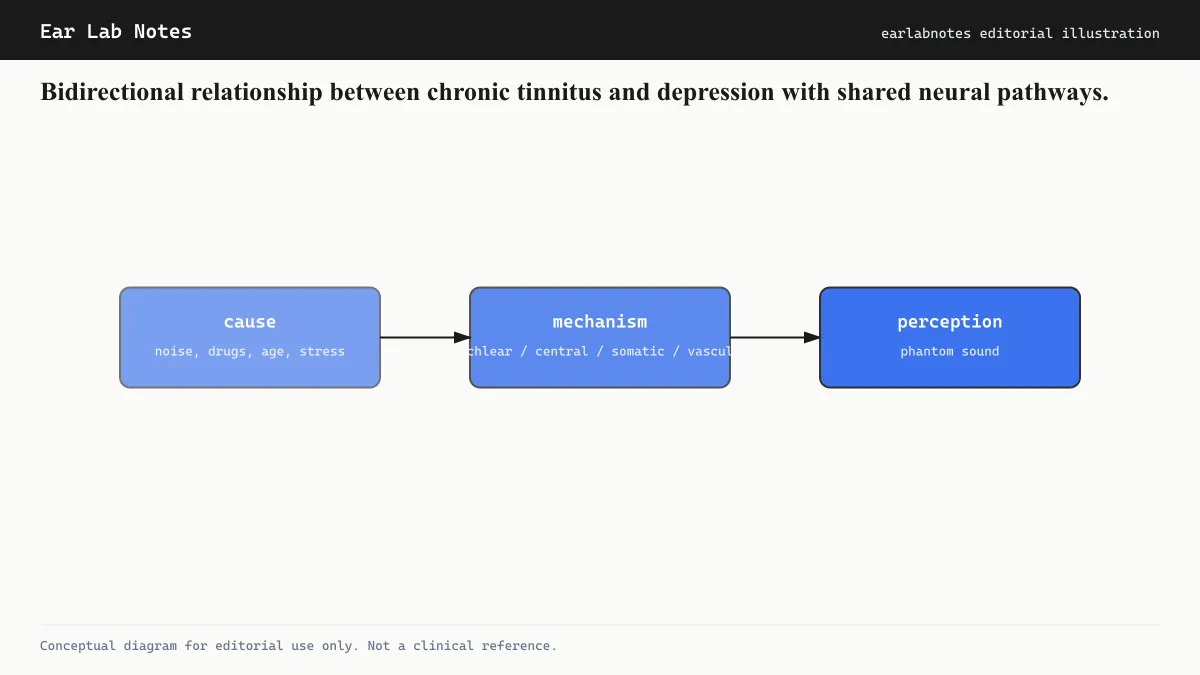
This bidirectional relationship is not coincidental.
Why the two conditions reinforce each other
Shared neurobiology
Both chronic tinnitus and depression involve the limbic system, the brain’s emotional-processing network. The amygdala, which assigns emotional weight to sensory signals, appears to play a role in both conditions. When the auditory cortex generates a persistent phantom signal, the amygdala can tag that signal as threatening, which sustains attention on the sound and drives distress.
At the same time, disruptions in serotonin and other neurotransmitter systems that are central to depression may also alter the processing of auditory signals. Researchers are still clarifying the direction of these effects.
The sleep pathway
Sleep disruption is one of the clearest routes between tinnitus and depression. Tinnitus is consistently louder at night when ambient sound drops. Poor sleep degrades mood regulation. Over weeks and months, chronic sleep disruption is one of the most reliably documented contributors to depressive episodes.
Loss of function and enjoyment
People with intrusive tinnitus often withdraw from social situations, restaurants, concerts, or any setting where background noise makes hearing and concentrating difficult. This behavioral withdrawal reduces the rewarding activities that help maintain mood, a mechanism well recognized in the behavioral model of depression.
Hypervigilance and helplessness
Many people who first notice tinnitus spend considerable energy trying to listen for it, track its intensity, or find an off switch. When no immediate solution appears, that effort can convert into a sense of helplessness, which is a well-described contributor to low mood over time.
What the clinical trial literature shows
Research into combined tinnitus and depression treatment has grown substantially over the past two decades. Several themes emerge:
Cognitive behavioral therapy, which is the most evidence-supported psychological intervention for tinnitus according to guidelines from bodies including the AAO-HNS, also reduces depressive symptoms in tinnitus populations, even when the CBT protocol was not designed specifically for depression. Trials have consistently shown reductions in both tinnitus handicap scores and depression screening scores after CBT.
Mindfulness-based therapies show more modest but broadly positive effects on mood in tinnitus studies, though the evidence base is smaller.
Tinnitus retraining therapy, which combines counseling with low-level broadband sound, has also been associated with improvements in mood, though its primary target is habituation rather than depression directly.
Across studies, improvement in tinnitus distress and improvement in depressive symptoms tend to travel together. Whether one change drives the other or whether both respond to a common intervention mechanism is difficult to separate.
What has not been clearly established
It is important to note what the research cannot currently confirm:
Antidepressant medications have not shown consistent benefit specifically for tinnitus perception or loudness in controlled trials. Some are used for tinnitus-related distress under clinical judgment, but this is distinct from an established treatment protocol.
Reducing tinnitus itself, rather than the distress around it, does not reliably lift depression in the way that treating depression sometimes reduces distress.
The evidence does not support any supplement or dietary intervention for the depression-tinnitus overlap.
Practical implications for people with chronic tinnitus
Mental health screening is now included in several professional tinnitus assessment guidelines. The British Tinnitus Association and NHS UK both acknowledge the psychological dimension of tinnitus management. If low mood, loss of interest, or feelings of hopelessness accompany tinnitus, that is clinically relevant information for any audiologist or physician.
Several considerations follow:
Tinnitus management that ignores mood is likely to be less effective. Most guidelines recommend that psychological support be offered alongside sound-based interventions when distress is significant.
Waiting for tinnitus to resolve before addressing mood, or waiting for mood to improve before engaging with tinnitus management, tends to prolong both. Concurrent treatment appears more effective.
Online CBT programs for tinnitus are increasingly available through health systems, including some evaluated in NHS-supported research, making psychological support more accessible than it was a decade ago.
The clinical screening picture
Depression screening is increasingly embedded in tinnitus assessment protocols. Validated questionnaires such as the Patient Health Questionnaire (PHQ-9) and the Hospital Anxiety and Depression Scale (HADS) are used alongside tinnitus-specific tools like the Tinnitus Handicap Inventory. The reason is practical: knowing the level of depressive symptoms at baseline helps clinicians choose the right intervention tier from the start, rather than discovering the psychological dimension after a sound-only intervention fails.
The British Tinnitus Association publishes guidance for both people living with tinnitus and for clinicians, and explicitly flags the need for psychological awareness in assessment. NHS UK clinical pathways for tinnitus also note the need to address comorbid mental health conditions.
What adequate treatment looks like
When both conditions are present, adequate treatment usually means more than a single appointment and a leaflet about white noise. It typically involves:
An audiological assessment to characterize the tinnitus, check for hearing loss, and determine whether a hearing aid or sound generator is appropriate.
Psychological support, delivered either as individual CBT with a trained clinician or through a structured self-help program based on CBT principles.
Regular follow-up to monitor both tinnitus distress and mood, since both can fluctuate with life events, sleep quality, and other health changes.
Some GP practices and audiology departments offer collaborative care models where these elements are coordinated. Where they are not, a person with significant tinnitus and depression may need to take the initiative of mentioning both conditions at every relevant appointment.
When to seek an assessment
Anyone who has experienced tinnitus for more than a few weeks and notices that it is affecting mood, sleep, or day-to-day functioning is encouraged to raise both issues at the same appointment. An audiologist can assess tinnitus severity and refer to appropriate psychological services. A GP can screen for depression and coordinate care.
The NIH/NIDCD and AAO-HNS both note that persistent tinnitus affecting quality of life warrants professional evaluation. Depression is a quality-of-life condition. Bringing the two together in one conversation, rather than managing each separately, is the approach most consistent with what the clinical evidence supports.
Neither condition should be managed in isolation.
If symptoms persist or change, see an audiologist or physician.
Related notes
Frequently asked
Questions readers ask
- Does tinnitus cause depression?
- Tinnitus does not directly cause depression, but chronic tinnitus is associated with higher rates of depressive symptoms. Persistent phantom sound can disrupt sleep, reduce enjoyment of activities, and create a sense of helplessness, all of which are recognized pathways toward low mood. Whether tinnitus leads to depression, or a shared vulnerability produces both, is still being studied.
- Can treating depression make tinnitus better?
- Some people report reduced tinnitus distress when depressive symptoms improve, but the relationship is not guaranteed to be reversible. Psychological treatments like CBT that address both conditions simultaneously tend to show the most consistent results in published trials.
- Are antidepressants helpful for tinnitus?
- A small number of trials have evaluated antidepressants specifically for tinnitus distress, with mixed results. Some antidepressants are themselves listed as ototoxic at high doses. Any decisions about medication belong to a prescribing clinician who knows your full health picture.
- What is the connection between the limbic system and tinnitus?
- The limbic system processes emotion and threat. Researchers believe that phantom sound signals from the auditory cortex can activate limbic structures, particularly the amygdala, in a way that assigns emotional weight to the ringing. This loop can perpetuate both tinnitus distress and low mood.
- Should I see a mental health professional if I have tinnitus?
- Many audiology and ENT guidelines recommend psychological support as part of comprehensive tinnitus care, especially when the condition is affecting daily functioning, sleep, or mood. A GP or audiologist can provide a referral.
Primary sources
Where this comes from
- ◆Tinnitus: Assessment and Management · NIH/NIDCD
- ◆Tinnitus Clinical Practice Guideline · AAO-HNS
- ◆Tinnitus and mental health · British Tinnitus Association
- ◆Tinnitus: Overview · NHS UK
- ◆Tinnitus information · Mayo Clinic
Educational use only.
If your symptoms persist or change, see a licensed audiologist or otolaryngologist. Sudden hearing loss is a medical emergency, see a clinician within 72 hours.
TEL-N039 · The Ear Lab · earlabs.app