The scale of the problem
Tinnitus is the most prevalent service-connected disability recognized by the U.S. Department of Veterans Affairs. Hundreds of thousands of veterans receive compensation for tinnitus each year, a figure that reflects both the intensity and duration of noise exposure common in military service and the permanence of noise-induced cochlear damage.
Among veterans who also have PTSD, the rates of tinnitus are even higher. The two conditions are not merely coincidental companions. They interact through overlapping neurological and psychological mechanisms in ways that compound the difficulty of managing either.
How military service produces tinnitus
Noise-induced cochlear damage
The primary mechanism is straightforward. NIOSH (the National Institute for Occupational Safety and Health, part of the CDC) documents that sustained exposure above 85 decibels damages cochlear hair cells in a dose-dependent relationship. Military environments routinely exceed this: small arms fire reaches 150 to 165 dB at the shooter’s ear, aircraft carrier flight decks average over 130 dB, and armored vehicle engines produce sustained exposure well above 85 dB.
Noise-induced damage destroys the outer hair cells that amplify faint sounds within the cochlea. The resulting loss of peripheral input is thought to trigger compensatory central-gain changes in the auditory pathway, producing the phantom signal of tinnitus.
Blast injury
Blast exposure adds a different injury pattern. The pressure wave from an explosion can damage the cochlea mechanically, rupture the tympanic membrane, and also produce diffuse neurological effects through traumatic brain injury. Blast-related tinnitus may have both peripheral and central components.
Cochlear synaptopathy, damage to the ribbon synapses between inner hair cells and auditory neurons, is increasingly recognized as a consequence of blast injury that standard audiograms miss. A veteran may present with a normal-appearing audiogram and significant tinnitus and auditory processing difficulties.
The PTSD-tinnitus interaction
Hypervigilance and auditory monitoring
PTSD is defined by several symptom clusters, one of which is hypervigilance: a state of sustained alertness to threat that does not turn off after the danger has passed. In combat veterans, hypervigilance often focuses specifically on auditory cues, sudden loud sounds, unexpected noises, any signal that might indicate approaching danger.
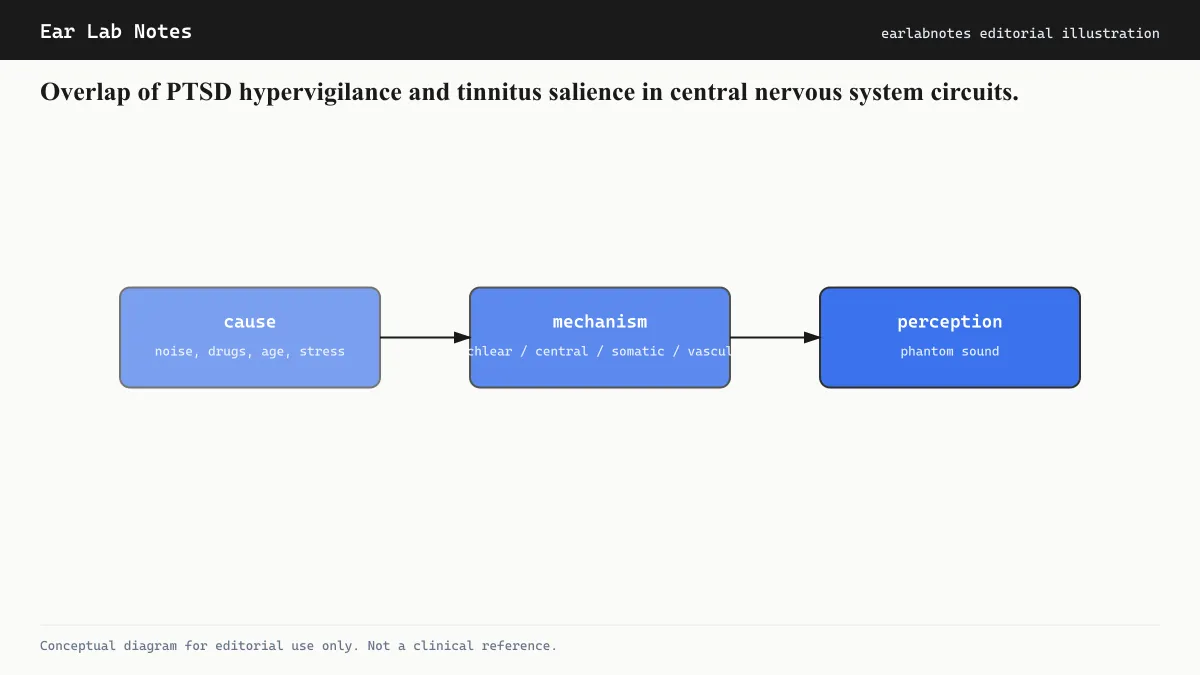
Tinnitus introduces a permanent internal sound that the hypervigilant nervous system cannot distinguish, at a subcortical level, from an external auditory threat signal. The amygdala and related threat-processing circuits can respond to tinnitus as if it were a potential danger, sustaining the hypervigilant state.
The result is that tinnitus keeps the threat-monitoring system active, and the threat-monitoring system keeps tinnitus salient. This is a self-reinforcing loop that is particularly difficult to interrupt.
Trauma triggers
For some veterans, the onset of tinnitus was simultaneous with a traumatic event: an explosion, a firefight, a vehicle accident. In these cases, the tinnitus itself can function as a trauma cue, a sensory reminder of the event that re-activates PTSD symptoms including intrusive memories, avoidance, and emotional reactivity.
This connection between the sound and the trauma makes it even harder for the nervous system to reclassify tinnitus as non-threatening, which is the process that underlies habituation.
Sleep disruption as a shared pathway
Both PTSD and tinnitus severely disrupt sleep. PTSD does so through nightmares, hyperarousal, and difficulty maintaining sleep. Tinnitus does so by being most noticeable in the quiet of the bedroom. Together they can produce chronic sleep deprivation that worsens cognitive function, emotional regulation, and both sets of symptoms.
What clinical guidelines recommend
Progressive tinnitus management
The VA audiology system has developed and evaluated a structured intervention called Progressive Tinnitus Management (PTM). It operates in tiered levels, from group education through individualized audiological and psychological support, and is designed to be scalable across the veteran population.
PTM incorporates sound therapy components, coping skills education, and when needed, collaboration with mental health providers. Published evaluations have shown it to be effective at reducing tinnitus handicap in veteran populations.
Integrated care for PTSD and tinnitus
VA guidelines recognize that tinnitus and PTSD should be managed in a coordinated way rather than in separate silos. Treating PTSD without addressing tinnitus leaves a persistent activator of the hypervigilant state in place. Treating tinnitus without addressing PTSD leaves the emotional reactivity that sustains tinnitus distress untouched.
CBT protocols that explicitly address both the trauma component and the tinnitus component are used in some VA settings, though access varies by location.
Sound enrichment
Sound enrichment during sleep and in quiet environments reduces the contrast that makes tinnitus salient and may reduce the frequency with which tinnitus triggers hypervigilant responses at night. This is a relatively low-burden intervention that can be introduced early in management.
The civilian overlap
While the veteran context is the most studied population for combined tinnitus and PTSD, the overlap is not exclusive to military service. Noise-induced tinnitus following a traumatic event, a workplace accident, an assault, or a catastrophic event involving loud sound, can occur alongside PTSD in civilian populations.
In these cases the same mechanisms apply. The tinnitus may be directly linked in the person’s memory to the traumatic event, functioning as a sensory cue that reactivates PTSD symptoms. And the PTSD hypervigilance sustains attention on the tinnitus in a way that prevents habituation.
Clinicians working with trauma survivors in general mental health settings are not always aware of the tinnitus-PTSD interaction. People in this situation may need to advocate for both conditions to be assessed, rather than assuming that treating the PTSD will resolve the tinnitus distress or vice versa.
Noise exposure prevention in high-risk environments
NIOSH publishes guidelines for occupational noise exposure that apply to military and high-noise civilian environments alike. Permissible exposure time at various decibel levels drops sharply above 85 dB: at 100 dB, NIOSH limits exposure to 15 minutes per day without hearing protection. At levels common in weapons fire and blast environments, no practical duration is safe without adequate protection.
Preventing noise-induced tinnitus in the first place is the most effective intervention. For people already in high-noise roles, hearing conservation programs that include proper hearing protection fitting, regular audiometric monitoring, and education about noise risk form the established prevention framework.
For veterans outside the VA system
Veterans in countries with their own military health systems, including the NHS in the United Kingdom, have access to tinnitus assessment through standard audiology services. The British Tinnitus Association provides resources specifically addressing tinnitus in veterans and military personnel.
Veterans in any system who experience tinnitus alongside PTSD symptoms are encouraged to raise both conditions explicitly in any clinical appointment. Each condition can influence the treatment approach to the other, and coordinated care between audiology and mental health services tends to produce more comprehensive improvement than sequential single-condition management.
If symptoms persist or change, see an audiologist or physician.
Related notes
Frequently asked
Questions readers ask
- Why is tinnitus so common in veterans?
- Military service involves sustained exposure to high-intensity noise from weapons, vehicles, aircraft, and explosives. Noise-induced cochlear damage is the most common cause of service-connected tinnitus. Blast injury also produces acoustic trauma and, in some cases, direct neurological damage to the auditory pathway.
- Is the tinnitus or the PTSD harder to treat when both are present?
- Clinicians who specialize in veteran care generally report that the two conditions interact in ways that make each harder to treat in isolation. PTSD hypervigilance keeps the nervous system in a high-alert state that sustains tinnitus salience, while constant tinnitus can serve as a trauma trigger, prolonging PTSD symptoms.
- Does tinnitus count as a service-connected disability?
- In the United States, tinnitus is the single most common service-connected disability recognized by the Department of Veterans Affairs. Veterans can pursue formal disability ratings through the VA claims process. Guidance is available through VA audiology and benefits offices.
- What treatments does the VA offer for tinnitus with PTSD?
- VA audiology programs offer progressive tinnitus management, a structured intervention developed specifically for veteran populations that combines education, sound-based strategies, and coping skills. When PTSD is present, mental health services are integrated. The VA also provides access to CBT for both conditions.
- Can blast injury cause tinnitus even without audiogram changes?
- Yes. Blast injury can produce tinnitus through cochlear synaptopathy, damage to the synapses between hair cells and auditory neurons, that does not show up on a standard audiogram. It can also cause direct central auditory pathway damage. Audiograms that look normal do not rule out blast-related auditory injury.
Primary sources
Where this comes from
- ◆Tinnitus: Assessment and Management · NIH/NIDCD
- ◆Noise and Hearing Loss Prevention · NIOSH/CDC
- ◆Tinnitus Clinical Practice Guideline · AAO-HNS
- ◆Tinnitus: Overview · Mayo Clinic
- ◆Tinnitus overview · NHS UK
Educational use only.
If your symptoms persist or change, see a licensed audiologist or otolaryngologist. Sudden hearing loss is a medical emergency, see a clinician within 72 hours.
TEL-N041 · The Ear Lab · earlabs.app