The app landscape
A search for tinnitus in any major app store returns hundreds of results. They range from simple white-noise generators to sophisticated platforms that claim to match and target an individual’s tinnitus frequency, deliver specialized neuromodulation protocols, or track symptom changes over time.
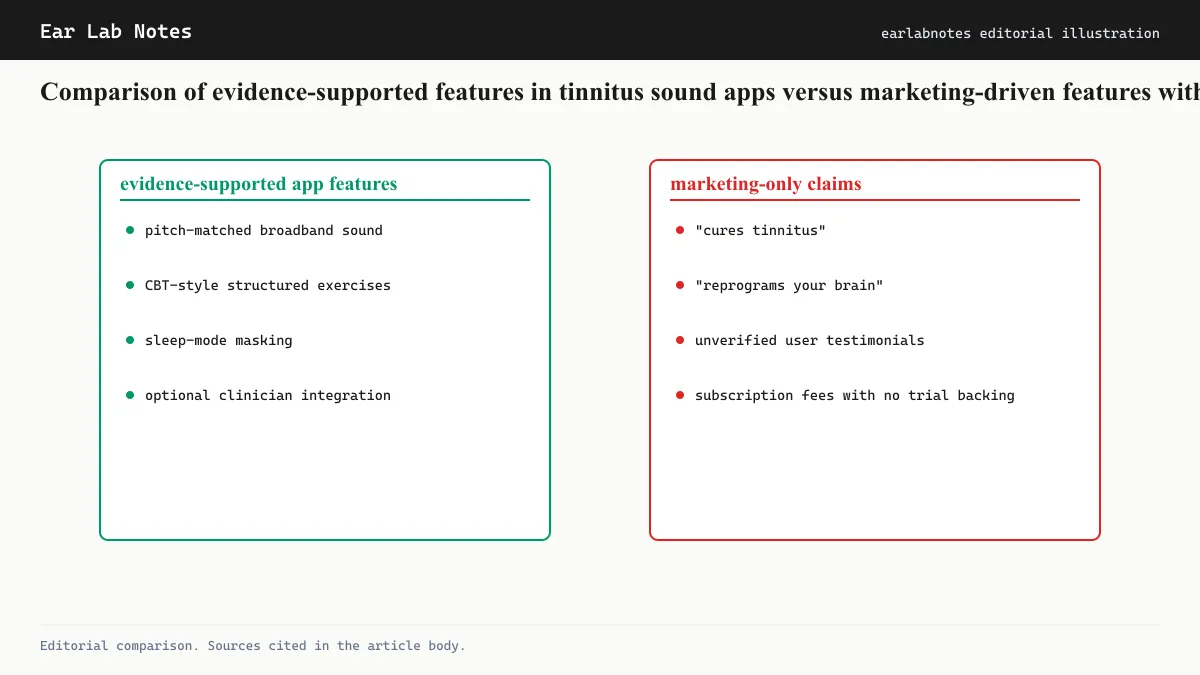
Most of these apps share a common characteristic: their marketing language substantially outpaces their evidence base. A useful tinnitus app should do a clear job, explain what stays on the phone or leaves it, and avoid presenting a self-reported change as proof of treatment.
That does not mean apps are useless. Several of the underlying sound therapy approaches that apps deliver, broadband masking, sound enrichment, and structured relaxation audio, have reasonable support from tinnitus research. The challenge is separating apps that implement these approaches sensibly from those that add layers of unfounded claims.
Features with reasonable evidence behind them
Broadband sound enrichment
The most straightforward and best-supported function of any tinnitus app is providing a library of broadband sounds: white noise, pink noise, brown noise, nature recordings, or combinations. These sounds reduce the acoustic contrast that makes tinnitus salient in quiet environments.
The evidence for broadband sound enrichment as a tinnitus management tool is established in clinical practice guidelines including those from the AAO-HNS and the British Tinnitus Association. An app that delivers this function well, with a range of sounds, volume control, and sleep timer functionality, is implementing something clinically grounded.
Tinnitus diary or tracking
Some apps include structured self-monitoring tools: daily ratings of tinnitus loudness, intrusiveness, and impact on sleep or concentration. This is clinically useful because tinnitus fluctuates and patterns often emerge over days or weeks that are not apparent from any single day’s experience.
Tracking data that can be shared with an audiologist or GP provides real-world information that supplements the limited snapshot available during a clinic appointment. The British Tinnitus Association and NHS guidance both note the value of understanding tinnitus patterns.
The private tinnitus diary on this site stores entries in your browser, needs no account, and exports a CSV file you can choose to share. It is a tracker, not a diagnostic test.
Privacy and export
A diary can contain sleep, stress, medication, and symptom notes. Before entering them, check whether the app needs an account, whether it sends entries to a server, whether data can be exported, and how deletion works. A clear local-only mode is useful for people who want pattern tracking without creating another health profile. If an app uses cloud sync, read its current privacy policy rather than assuming the app-store privacy label covers every data flow.
CBT-based educational content
A smaller number of apps include psychoeducational material based on CBT principles: explanations of the tinnitus-attention loop, guided exercises for cognitive restructuring, and audio relaxation practices. Where this content is developed in consultation with clinical psychologists and reflects established CBT-for-tinnitus protocols, it can supplement face-to-face therapy or provide an accessible entry point for people on waiting lists.
The quality of this content varies enormously between apps. Apps affiliated with academic audiology research centers or national hearing charities tend to have more reliable content.
Features with limited or no evidence
Frequency-targeted neuromodulation
Many apps claim to generate sounds at the precise tinnitus frequency to suppress or “cancel” it. The theoretical basis for this varies and is often vague. Where it references research, it typically cites notched music therapy trials, which are themselves small and show modest effects, without being clear that the app’s implementation matches the studied protocol.
Simple frequency matching through a consumer app on a smartphone speaker or typical earphones does not replicate the controlled acoustic delivery of a clinical study, which matters for interventions where spectral precision is claimed to be important.
Claims of tinnitus cure or elimination
Any app claiming to cure or permanently eliminate tinnitus is overstating what the evidence permits. No sound therapy approach, in app or device form, has been shown to cure tinnitus. The NIH/NIDCD explicitly notes that while tinnitus management options exist, no reliably curative treatment is currently established.
This includes claims about “neuroplasticity training,” “auditory cortex reset,” or any similar framing that implies permanent structural change from passive app use.
AI personalization without published validation
Several apps feature AI-driven personalization: algorithms that claim to adapt the sound therapy to the user’s tinnitus in real time. Some of these systems may have genuine utility, but without published validation studies that demonstrate clinical benefit beyond a simple broadband approach, the AI framing adds marketing appeal without established clinical value.
How to evaluate a tinnitus app
Several practical filters can help distinguish more credible apps from less credible ones:
Does the app cite published research, and can those citations be verified? A PubMed search for any claimed study title takes thirty seconds and immediately distinguishes apps that reference real research from those that do not.
Who developed the clinical content? Apps developed in partnership with university audiology departments, hearing charities, or health system providers are more likely to have had appropriate clinical review.
Does the app make specific treatment claims or general wellness claims? Apps that describe themselves as supporting relaxation or sound enrichment are making more defensible claims than those promising measurable tinnitus reduction.
Does the app encourage professional assessment? Reputable tinnitus apps note that a clinical evaluation is recommended for persistent or worsening tinnitus. Apps that actively discourage or bypass clinical care warrant skepticism.
Apps affiliated with clinical institutions
A small number of tinnitus apps have been developed in partnership with university audiology departments, national health services, or hearing charities. These tend to include:
Structured psychoeducational content reviewed by clinicians with tinnitus expertise.
Sound libraries designed based on established sound therapy principles, with volume guidance included.
Features that support integration with professional care, such as structured tinnitus diaries that can be shared with a clinician.
The British Tinnitus Association has evaluated and endorsed specific apps for different aspects of tinnitus management. NHS UK hearing clinics in some regions point patients toward app-based resources as adjuncts to face-to-face care. These institutional endorsements, while not equivalent to clinical trial evidence for a specific app, are more meaningful than app store ratings.
What apps cannot replace
Apps are supplementary tools. They cannot perform an audiological assessment, measure hearing thresholds, assess the cause of tinnitus, or identify red-flag features that warrant urgent medical evaluation.
AAO-HNS guidelines identify several clinical red flags in tinnitus that require prompt professional assessment: tinnitus in only one ear, tinnitus accompanied by sudden hearing loss, tinnitus with vertigo or balance disruption, and pulsatile tinnitus. An app cannot screen for these. Anyone with new, worsening, or unusual tinnitus should have a clinical evaluation before relying on any app as their primary management tool.
For people who have already had a clinical assessment and are managing stable tinnitus, a well-chosen app can meaningfully support their ongoing management as a convenient, low-cost adjunct to professional care.
Volume and hearing safety
Any app delivering sound through earphones raises the question of volume. Self-selected listening volumes through earphones can easily exceed NIOSH’s recommended maximum continuous exposure level of 85 dB. Most smartphones include some form of volume warning above certain thresholds, but these are not calibrated to clinical safety standards.
For extended use, moderate volume well below the maximum, at a level that masks tinnitus without straining to hear it, is the appropriate target. The British Tinnitus Association and NHS UK both include volume guidance in their sound enrichment recommendations, and those principles apply to app-delivered sound regardless of the delivery device.
If symptoms persist or change, see an audiologist or physician.
Related notes
Frequently asked
Questions readers ask
- Are tinnitus apps medically approved?
- Most tinnitus apps in consumer app stores are wellness products, not regulated medical devices. A small number have been submitted to regulatory processes in specific countries, but the majority are not subject to clinical approval requirements. This makes it especially important to evaluate them based on what evidence underlies their claims.
- Can an app measure my tinnitus pitch?
- Some apps include tone generators that allow users to attempt pitch matching by finding the frequency closest to their perceived tinnitus. This is a simplified version of the clinical procedure audiologists perform. Self-matched pitch from an app is not a clinical measurement and should not replace a formal audiological assessment.
- What is notched sound therapy in a tinnitus app?
- Notched sound therapy removes a narrow frequency band from music or noise centered on the user's tinnitus pitch. The theory, based on lateral inhibition in the auditory cortex, is that depriving that frequency band of stimulation reduces the cortical overactivation associated with tinnitus. Some controlled trials have examined this approach; results are mixed and effect sizes modest.
- Why do so many tinnitus apps have poor evidence despite high ratings?
- App store ratings reflect user satisfaction, which is influenced by design, ease of use, customer support, and subjective experience rather than clinical outcomes. A well-designed app that produces pleasant sounds can receive high ratings from users who find it helpful without this demonstrating efficacy beyond placebo or general relaxation effects.
- Should I use a tinnitus app instead of seeing an audiologist?
- Apps are not a substitute for clinical assessment. The AAO-HNS guideline recommends that people with persistent or worsening tinnitus have a clinical evaluation. Apps may be useful as supplementary tools between appointments, for sound enrichment at home, or for tracking tinnitus in a structured way that can be shared with a clinician.
Primary sources
Where this comes from
- ◆Tinnitus: Assessment and Management · NIH/NIDCD
- ◆Tinnitus Clinical Practice Guideline · AAO-HNS
- ◆Tinnitus sound therapy · British Tinnitus Association
- ◆Tinnitus: Diagnosis and treatment · Mayo Clinic
- ◆Tinnitus overview · NHS UK
Educational use only.
If your symptoms persist or change, see a licensed audiologist or otolaryngologist. Sudden hearing loss is a medical emergency, see a clinician within 72 hours.
TEL-N044 · The Ear Lab · earlabs.app